
How to Improve SEO for Manufacturing Website
If you run a factory, plant, or component-supply brand, your website is usually the first place engineers and procurement teams look before contacting you. Many manufacturers assume that “looking good” is enough for SEO, but industrial buyers search in very specific ways that most generic SEO tactics don’t cover.
This post answers the core question: “What are the best SEO strategies for manufacturing websites, and how can manufacturers improve industry-specific SEO to drive real industrial leads?” Instead of vague theory, you’ll get clear, actionable tactics you can apply to your own site.

May 27, 2026
12 Min Read
SEO Manufacture
The best SEO strategies for manufacturing websites combine technical SEO, on-page optimization, and content tailored to industrial buyers
Manufacturers should focus on long-tail, problem-driven keywords that match how engineers and procurement teams search (not just broad head-terms).
Clear product-page structure, detailed specs, FAQs, and supporting content materially improve both rankings and lead-quality signals.
Manufacturing-specific SEO includes niche keyword research, technical site health, and b2b-style content that mirrors long-sales-cycle buying journeys
A simple 30–60 day optimization workflow lets small manufacturers move the needle on SEO without needing a full agency.

Manufacturing websites often serve fewer, high-value buyers compared to consumer e-commerce, but each lead can be worth tens or hundreds of thousands of dollars in revenue. SEO matters here because:
Engineers and procurement teams routinely search for exact part types, service capabilities, tolerances, and industry certifications before they contact a vendor.
Showing up for those queries turns your site into a 24/7 sales engineer that answers questions and qualifies interest before the first human interaction.
Over time, strong SEO can position your brand as a trusted, go-to source in your niche, not just a listing among competitors.
For you, SEO isn’t about vanity rankings; it’s about how to improve SEO on a manufacturing website so it surfaces for the right industrial queries and converts those visitors into quotes and RFQs.
Consumer SEO focuses on high-volume, transactional keywords and quick purchases. Manufacturing SEO follows a very different pattern:
Fewer, higher-value buyers, often with technical or procurement teams involved.
Multi-word, highly specific queries (e.g., “precision CNC machining services for aerospace parts under ₹X per unit in India”).
Long decision-making timelines, multiple stakeholders, and often heavy documentation.
Buyers want detailed specs, tolerances, case studies, and technical data, not just attractive product photos.
Because of this, the best SEO strategies for manufacturing websites need to be b2b-oriented and deeply technical. They treat every page as a mini-guide that answers a real-world production or engineering question.
Manufacturing SEO rests on three pillars that must work together: technical SEO, on-page SEO, and off-page SEO, each tuned to your industrial context.
Technical SEO ensures search engines can find, understand, and index your content quickly and accurately. For manufacturing sites, this means:
A clean site structure with clear categories and product groupings.
Fast load times and mobile-friendliness that don’t lose engineers researching on tablets at the plant.
Accurate schema and structured data (Product, Offer, BreadcrumbList, Organization) that describe what you sell and who you are.
If your site is slow, poorly organized, or lacks schema, industrial buyers may never see your pages, no matter how strong your on-page work is.
On-page SEO turns your product and category pages from basic listings into answer-rich pages that both humans and search engines understand. For manufacturing websites, this means:
Clear, descriptive titles and headings that include key terms (e.g., “CNC Machining Services for Aerospace Components in India”).
Body content that explains what the product or service is for, who it’s designed for, and how it meets real-world use cases.
Strategic internal links that guide users from broad categories down to specific SKUs and from problems to solutions.
Well-optimized on-page content is one of the best ways to how manufacturers can improve industry-specific SEO.
Off-page SEO builds your brand’s reputation and authority through signals outside your site. For industrial brands, this includes:
Backlinks from credible B2B or industry-specific sources (engineering blogs, trade directories, industry publications).
Consistent brand mentions and citations across manufacturer directories and supplier platforms.
These signals confirm to search engines that your manufacturing business is recognized and trusted in your niche. They don’t replace on-page and technical SEO, but they amplify its impact.
Keywords for manufacturing sites should reflect how engineers and procurement teams actually search, not generic marketing phrases.

Engineers rarely search in short phrases. They ask:
“Does this servo motor support overload protection for continuous operation?”
“What is the maximum operating temperature of this industrial gasket?”
Search engines increasingly see these as high-intent, long-tail queries. Optimizing for them lets you:
Compete on specificity instead of budget.
Attract qualified leads who are already deep in their research
For your site, this means creating pages that mirror these question structures instead of generic product blurbs.
1. Start with broad product or service terms (e.g., “CNC machining,” “precision casting”).
2. Add modifiers like application, material, tolerance, and geography (e.g., “aerospace CNC machining services in Gujarat”).
3. Group keywords into intent buckets:
Problem-based (e.g., “What materials are suitable for high-temperature seals?”).
Comparison-based (e.g., “CNC vs laser cutting for metal parts”)
RFQ- or quotation-style queries.
A lean, problem-driven keyword map helps you how to improve SEO on a manufacturing website by aligning content with real-world buyer questions.
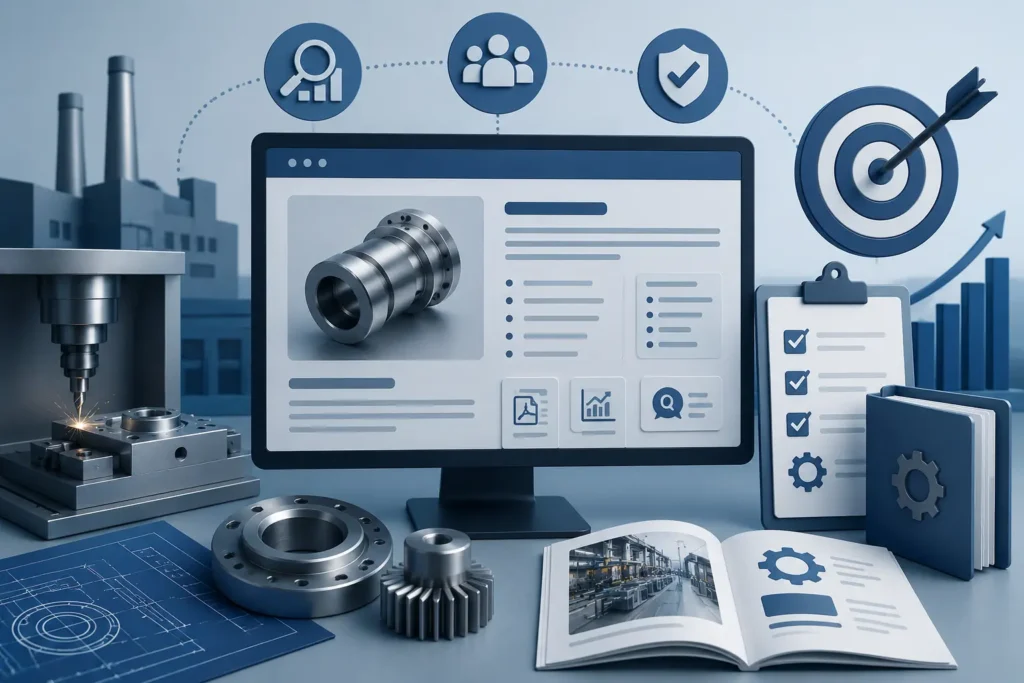
Every high-value product or service page should answer:
What it is and who it’s for.
Key specs (tolerances, materials, load ratings, certifications).
Typical use cases and how it compares to alternatives.
Use:
Clear headings and subheadings.
Bullet-point specs and short paragraphs explaining why those specs matter.
FAQs and downloadable datasheets that act as SEO-friendly blocks
These improvements make it easier for search engines to surface your pages and for engineers to trust your capabilities.
Beyond product pages, create supporting content that answers “how-to,” “why-choose,” and “case-study” questions, such as:
“How to choose the right precision machining partner for aerospace.”
“Case study: automation line for small-batch production.”
“FAQs about CNC machining tolerances.”
These pages:
Build topical authority that search engines reward.
Attract backlinks from industry and B2B sources
Technical SEO is especially important for manufacturing because complex product structures and niche content make indexability and schema accuracy critical.
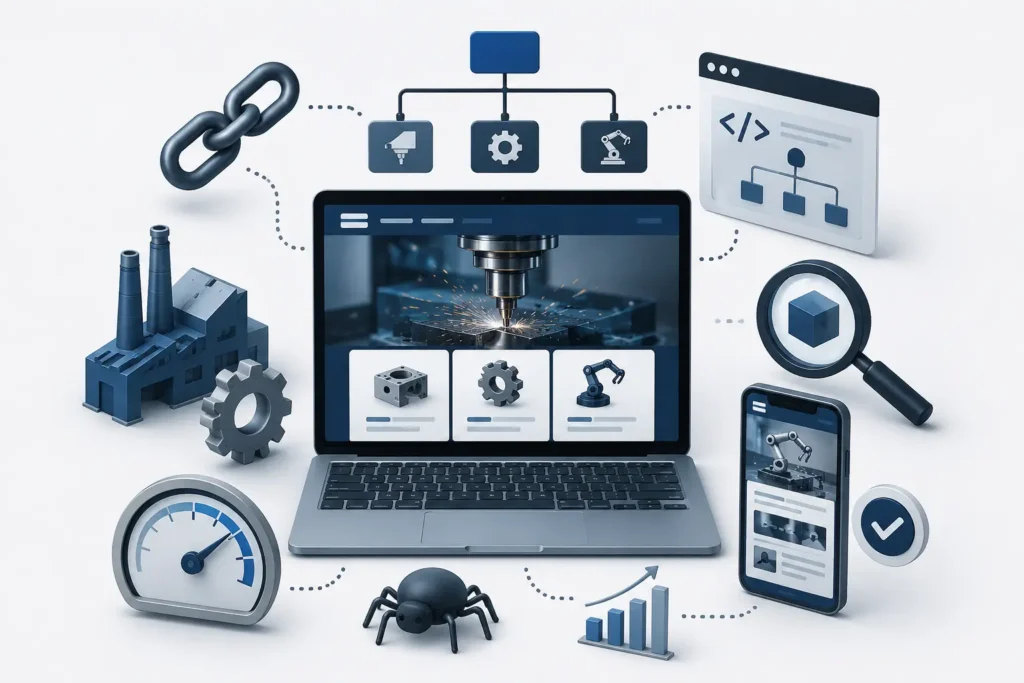
Organize your site so categories mirror real-world product groupings (e.g., “Machining Services,” “Casting & Molding,” “Automated Assembly”). Use internal links that guide users from broad to specific offers and from problems to solutions. Clear breadcrumbs and navigation help both buyers and search engines find the right pages.
Use schema types like Product, Offer, BreadcrumbList, and Organization to describe what you sell and who you are. Ensure schema matches the visible content so search engines can trust it. Rich snippets sourced from these signals can improve your visibility in product and image-type searches
Even highly technical manufacturing sites need decent load times and mobile responsiveness because engineers often search on tablets or phones. Optimize large images, simplify heavy scripts, and ensure your site is fully crawlable so search engines can reach all important pages.
Off-page SEO supports your manufacturing SEO but cannot fix weak on-page or technical foundations.
Prioritize backlinks from:
Industry-specific blogs and engineering portals.
Trade directories and B2B publications.
Partner sites and case-study features
Focus on earning links through original content, case studies, and expertise-driven outreach instead of spammy tactics.
Keep your business information (name, address, phone, website) consistent across manufacturer directories, supplier platforms, and B2B marketplaces. Accurate, consistent citations reinforce your brand’s legitimacy and improve your chances of appearing alongside competitors.
You don’t need a big overhaul to start seeing results. A simple 30–60-day workflow is enough.
Audit Your Manufacturing Site
Check indexability, broken pages, and internal linking.
Review product- and category-page content and current keyword targeting.
Identify the biggest gaps between your current state and your target rankings.
Fix Critical Technical and On-Page Issue
Address technical issues that block indexing or degrade user experience.
Rewrite or enhance your most important product and category pages so they clearly answer buyer questions.
Build and Optimize Industrial-Focused Content
Plan and publish 3–5 deeper pieces of content (guides, case studies, comparison pages) that target high-intent, long-tail keywords.
Ensure each links back to your core product or service pages.
Start Off-Page and Authority-Building Activities
Submit to key industry directories and publish guest articles or case studies on niche B2B sites.
Track these links and let them compound over time.
This routine is one of the best SEO strategies for manufacturing websites because it’s repeatable and scales with your bandwidth.

SEO for industrial brands typically takes 6–12 months to show meaningful, stable results, especially if your site needed technical or content improvements. Early gains may come from fixing obvious issues, but deeper progress depends on earning trust through content, backlinks, and consistent visibility.
For you, this means setting internal expectations at 3-, 6-, and 12-month milestones instead of demanding instant rankings.
The best SEO strategies for manufacturing websites combine technical SEO (indexability, speed, schema), on-page optimization (clear product pages, long-tail keywords), and supporting content that answers real-world engineer and procurement questions; these together build topical authority and help you compete for niche industrial terms.
Manufacturers can improve industry-specific SEO by mapping long-tail, problem-driven keywords to product and service pages, enhancing technical site health, and adding detailed specs, FAQs, and case studies; this approach signals to search engines that your site speaks directly to industrial buyers’ real-world needs.
Choose the right SEO keywords by starting with core product or service terms, then adding modifiers like application, material, tolerance, and geography to create long-tail, intent-rich phrases that match how engineers search; prioritize phrases that imply high-intent buying or RFQ activity over generic head-terms.
Important technical SEO changes include improving site structure and navigation, ensuring your site is fast and mobile-friendly, fixing crawl errors, and implementing accurate schema for products and your business; these changes make it easier for search engines to understand and surface your manufacturing content.
Content is critical for SEO on a manufacturing website because detailed product explanations, FAQs, case studies, and guides help search engines match your pages with specific, long-tail industrial queries while also building trust with engineers and procurement teams who need reliable information before contacting you.
SEO for a manufacturing business typically takes 6–12 months to show stable, meaningful results, especially if your site needs technical fixes or content upgrades; early progress may come from obvious fixes, but deeper, lead-driven improvements usually emerge as content and authority compound over time.
Yes, small manufacturers can compete with big brands in SEO by focusing on niche, long-tail keywords and highly specific, problem-driven content that large brands often overlook; this lets you dominate smaller, high-intent search segments and earn trust from targeted industrial buyers without needing massive budgets.
Senior SEO Strategist — Growth Naavik
With over 10+ years of experience in SEO and digital marketing, the author specializes in driving organic growth and improving search visibility for businesses across various industries. Their expertise includes SEO, AI SEO, LLM SEO (Large Language Model Optimization), technical SEO, content strategy, on-page and off-page optimization, local SEO, eCommerce SEO, and AI-driven search optimization. With a strong focus on evolving search technologies and organic growth strategies, they help brands adapt to modern search ecosystems and achieve long-term digital success.