
Amazon PPC Bidding Strategy
How to Choose & Optimise Bids for Better Performance

Tushar Prajapati
Jul 13, 2026
12 Min Read
Table of Contents
Quick Insights
Key Takeaways
Amazon has three bidding strategies Dynamic Bids Down Only, Dynamic Bids Up and Down, and Fixed Bids — and each suits a different campaign goal
Bidding strategy and bid amount are two separate levers; changing one without addressing the other rarely improves ACoS
Dynamic Bids Up and Down is for launches and ranking pushes; Down Only is for mature, profitable campaigns with consistent conversion data
Placement bid adjustments for Top of Search, Product Pages, and Rest of Search are a separate layer — and most sellers leave them at 0%
Your starting bid should be calculated from your target ACoS, not Amazon's suggested bid range
Wait 7–14 days before optimising bids decisions made on 3 days of data produce noise, not signal
Amazon PPC Strategy
Why Pet Sitting Marketing Is Different from Generic Small Business Marketing
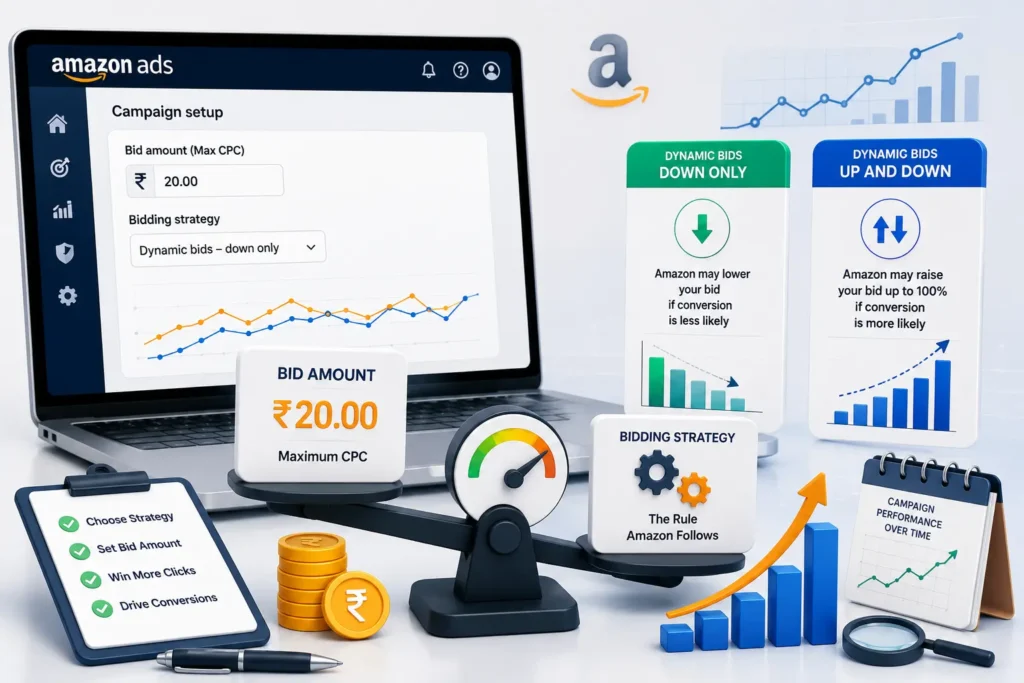
Amazon’s bidding interface gives you two settings that look similar but do very different things. Your bid amount is the maximum CPC you’re willing to pay per click. Your bidding strategy is the rule that tells Amazon whether to use that amount exactly, reduce it, or exceed it when competing in an auction. Most sellers focus on the number and overlook the rule entirely.
Why bid strategy and bid amount are two different levers
This distinction matters because changing only your bid amount while leaving the strategy unchanged often produces unexpected results. A seller who drops their keyword bid from ₹20 to ₹12 while running Up and Down may still end up paying ₹22 on a placement Amazon thinks will convert. The mechanics are governed by the strategy setting not just the number.
The mistake sellers make at campaign setup — and why it compounds over time
Getting the strategy right early prevents structural problems later. A campaign built on the wrong strategy from week one tends to either accumulate overspend (from Up and Down applied to campaigns that don’t need ranking aggression) or under-deliver on visibility (from Down Only applied to a new product that needs to compete for its first sales and ranking data). The fix is knowing what each strategy does before you activate it.
Manufacturing SEO
The Three Amazon Bidding Strategies — And When to Use Each
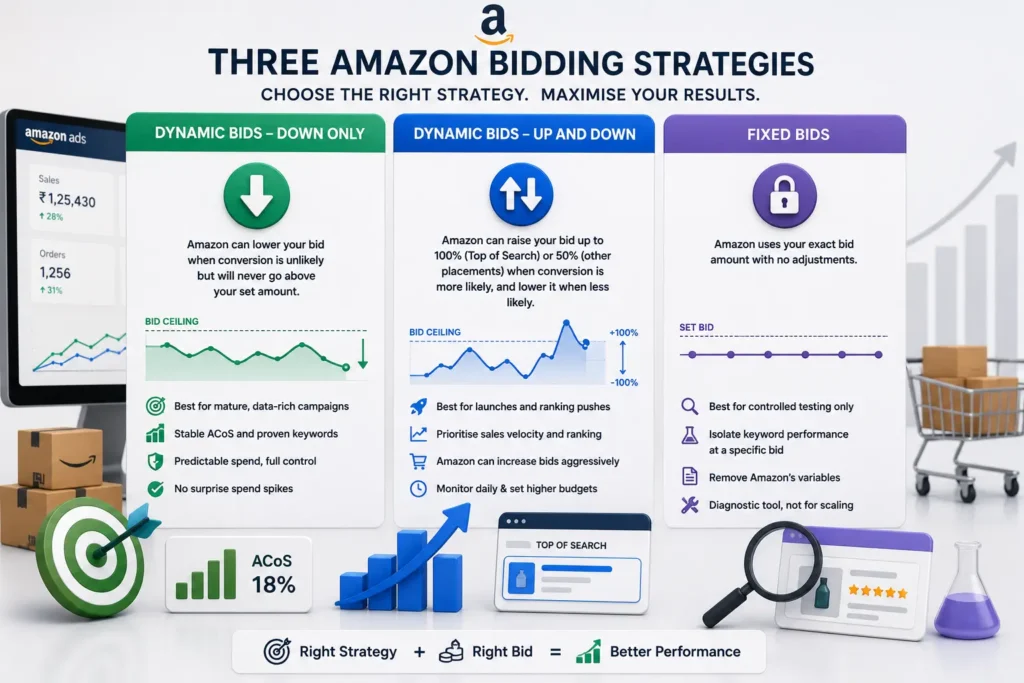
Amazon Sponsored Products offers three bidding strategies. Each serves a different purpose. The right choice depends on where your product is in its lifecycle and what you’re optimising for at this stage of the campaign.
Dynamic Bids — Down Only: use this for mature, data-rich campaigns
Down Only tells Amazon it can lower your bid when a conversion is unlikely but it will never go above your set amount. This gives you the most control of the three options. There are no surprise spend spikes, and Amazon won’t bid beyond your ceiling chasing a placement it predicted would convert.
It's the wrong strategy for new product launches or products trying to build ranking velocity. Applying Down Only to a new product is running ads with the handbrake on your campaigns will technically be active, but you won't compete for Top of Search placements where early sales rank and keyword history are built.
Dynamic Bids — Up and Down: use this for launches and ranking pushes
Up and Down gives Amazon authority to adjust your bid in both directions. For Top of Search placements, Amazon can raise your bid by up to 100% above your set amount when it predicts a conversion is more likely. For other placements, the ceiling is 50%. It can also reduce your bid when a conversion is less likely.
Apply Up and Down selectively. Not every campaign in your account needs ranking aggression. Use it for campaigns targeting your core ranking keywords and keep Down Only on ad groups targeting secondary or long-tail terms where Top of Search competition isn't worth the premium.
Fixed Bids: the one scenario where this makes sense
Fixed Bids means Amazon uses exactly your set amount without any adjustment. No conversion prediction, no dynamic movement — your bid stays the same whether your ad appears at the top of page 1 or somewhere on page 3.
Placement Bid Adjustments
Placement Bid Adjustments — The Layer Most Sellers Skip
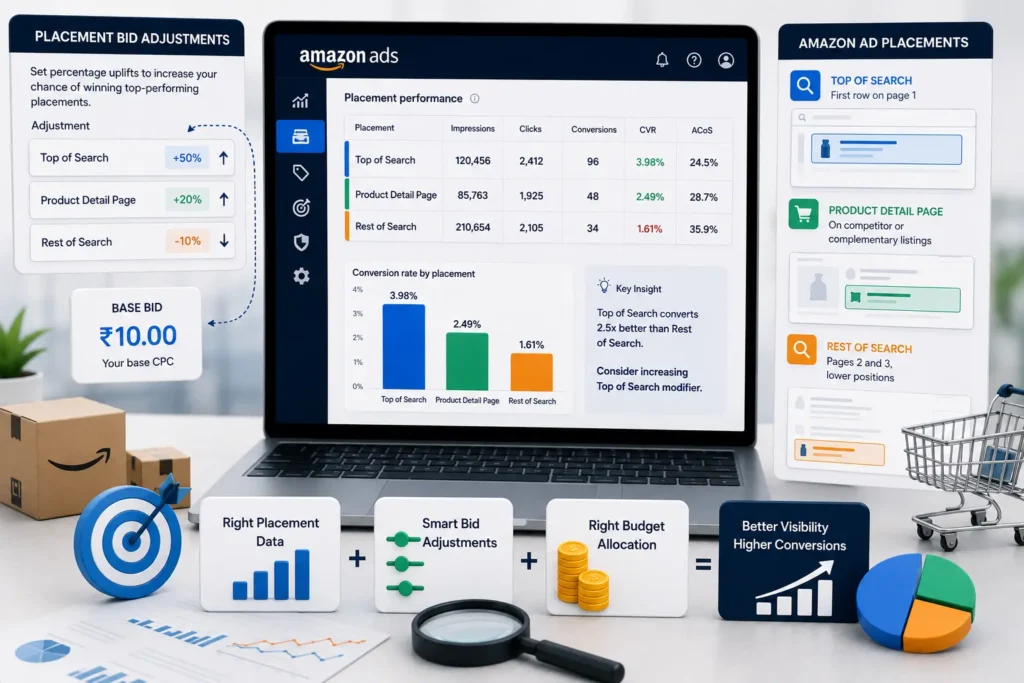
Bidding strategy controls how Amazon adjusts your bid in real time during an auction. Placement bid adjustments are a separate layer a percentage uplift you set per placement type that tells Amazon how much more you’re willing to pay to appear in that specific position. The two settings work together, but they’re configured in different places and most sellers have never set a placement modifier at all.
Top of Search vs. Product Detail Page vs. Rest of Search — what placement data tells you
To see your actual conversion rate by placement, go to your campaign in Seller Central, click into the campaign, and open the Placement tab. This report shows impressions, clicks, and conversions broken down by placement type. If your Top of Search conversion rate is 2x your Rest of Search rate, you are likely under-bidding for that placement and losing it to competitors who set modifiers. If Product Detail Page shows a high click rate but a low conversion rate, you may be spending on traffic that isn’t buying and a reduced modifier, or 0%, on that placement will redirect budget toward the one that converts.
The Placement tab is one of the most useful and least-visited reports in the Amazon advertising console. If you haven’t looked at it in the last 30 days, you likely have at least one placement either consuming budget it doesn’t deserve or being under-funded despite strong conversion data.
How to set placement modifiers without exhausting your budget
Before adding modifiers above 50%, adjust your daily budget upward to compensate, or your ads will exhaust the budget on top placements by mid-morning and go dark for the rest of the day. A practical starting point: set a 30–50% Top of Search modifier on campaigns where your Placement tab shows a Top of Search conversion rate at least 1.5x higher than your account average. Review performance after 7–10 days of data before increasing it further.
Calculate Your Starting Bid
How to Set Your Starting Bid Without Guessing
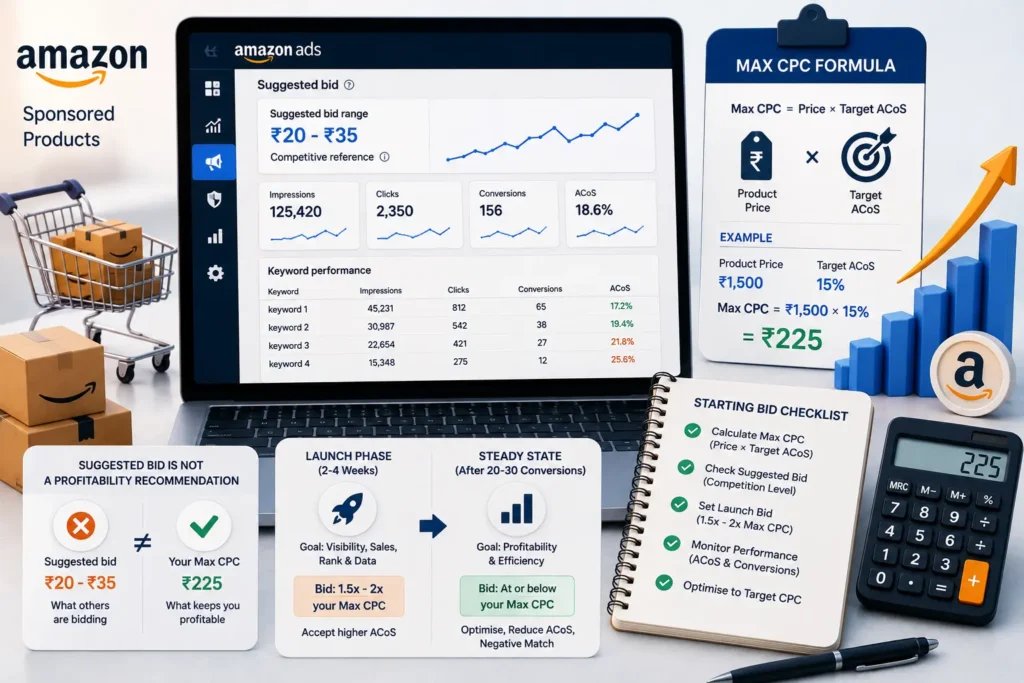
Amazon’s Suggested Bid range shows what other advertisers in your category are currently bidding for a given keyword. It is a competitive reference point not a profitability recommendation. A keyword showing a suggested bid of ₹20–₹35 may require a bid of ₹10 to remain within your target ACoS. Bidding at the suggested mid-range without a profitability check is one of the fastest ways to run a campaign that spends well but converts at a loss.
The ACoS-based formula for calculating your max CPC
What most sellers get wrong is treating the suggested bid as a floor. Your max CPC is the floor — the number below which you’ll undercut yourself on competitive keywords. The suggested bid tells you what you’re competing against. Those are different pieces of information, and they should inform your bid in different ways.
Launch bids vs. steady-state bids — why they should be different numbers
Once a keyword has 20–30 conversions recorded, you have a real ACoS to work with. At that point, adjust bids toward your target max CPC, consider switching from Up and Down to Down Only on those keywords, and move terms that haven’t converted after significant spend to negative match. The launch phase and the optimisation phase require different bids running the same numbers through both loses you efficiency in one and rank-building opportunity in the other.
Optimise Amazon PPC Bids
Amazon PPC Bid Optimization: When and How to Adjust
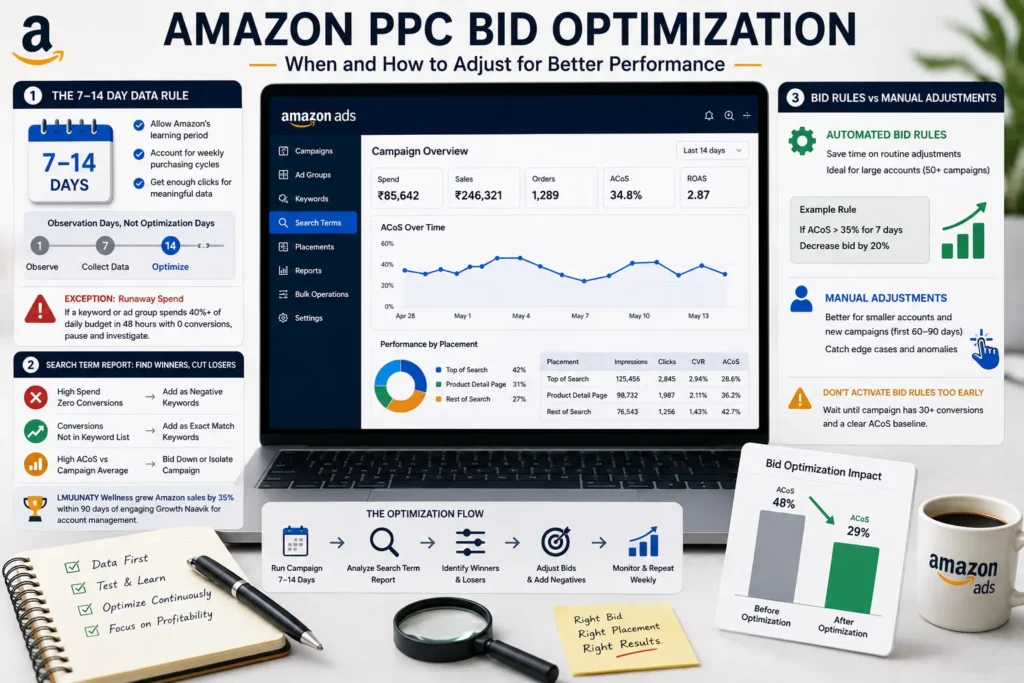
Bid optimisation done too early produces noise, not improvement. Sellers who adjust bids after three days of data are making structural decisions based on patterns that haven’t stabilised yet. The 7–14 day observation window accounts for weekly purchasing cycles, Amazon’s campaign learning period, and the minimum clicks needed to see a statistically meaningful conversion rate.
The 7–14 day data rule — why you shouldn’t touch bids before you have enough data
The exception is runaway spend. If a single keyword or ad group consumes 40% or more of your daily budget within the first 48 hours with zero conversions, pause it and investigate. That’s spend control not optimisation. Routine bid adjustments should wait for the full 7–14 day window.
Using the Search Term Report to find bid winners and cut losers
Look for three patterns: search terms with high spend and zero conversions (add as negative keywords immediately); search terms with conversions that aren’t in your keyword list (add as exact match keywords, bid based on their actual conversion data); and search terms matching your target keywords but running at a much higher ACoS than your campaign average (bid these down or isolate them into their own campaign for closer management). LMUUNATY Wellness grew Amazon sales by 35% within 90 days of engaging Growth Naavik for account management — a result built in part on this kind of systematic Search Term Report review applied consistently across their entire account, not just once at launch.
Bid rules vs. manual adjustments — what to automate and what to keep in your hands
The common mistake is activating bid rules before a campaign has enough data for the rule to make good decisions. A rule set on 15 days of data will make confident adjustments based on a pattern that hasn’t fully emerged. Set automated rules only after a campaign has 30+ conversions and a clear ACoS baseline before that point, manual weekly reviews take less time and produce more accurate decisions.
Amazon PPC Strategy Mistakes
Two Bidding Mistakes That Silently Kill Campaign Performance
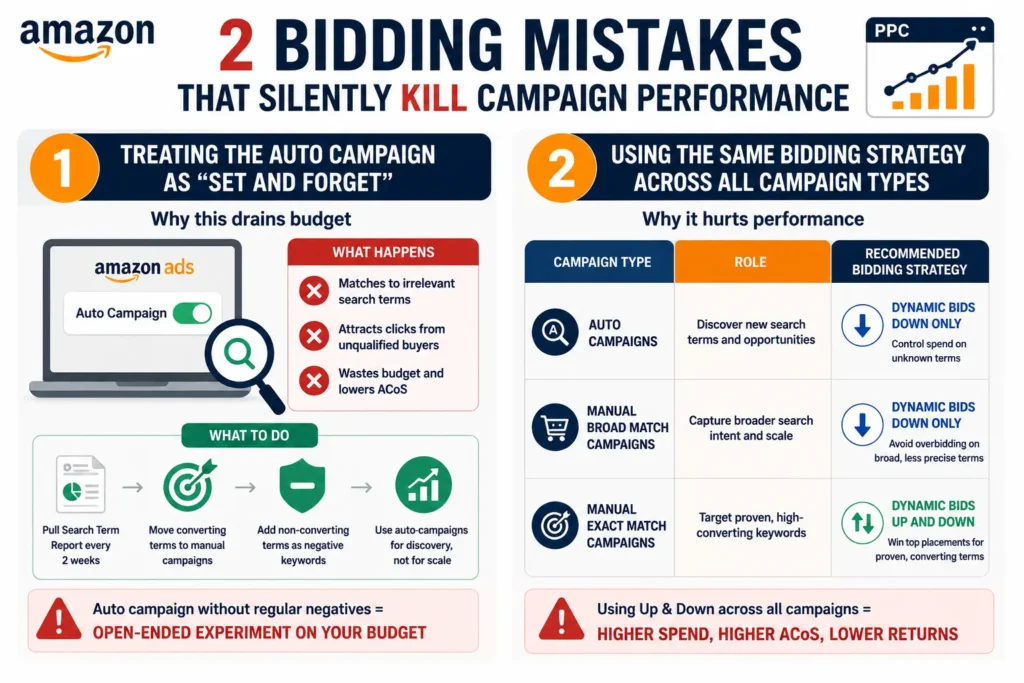
These two patterns appear in the majority of Amazon PPC accounts. Neither is obvious when you’re building the campaign structure both become expensive over time.
Treating the auto campaign as “set and forget” — why this drains budget
Automatic campaigns use Amazon’s algorithm to match your ads to search terms it considers relevant to your product. They’re genuinely useful for discovery finding converting search terms you didn’t think to target. Left unreviewed, they become an expensive experiment. Without negative keywords added regularly, an auto campaign will match your ads to loosely related terms that attract clicks from buyers not looking for your product.
An auto campaign with no negative keyword updates after 30 days is running an open-ended keyword test on your budget. Pull the Search Term Report every two weeks, move converting terms into your manual campaigns as exact match keywords, and add non-converting terms to the negative keyword list. Auto campaigns work best as a discovery feed — not as a standalone source of sales volume.
Using the same bidding strategy across all campaign types
Auto campaigns, manual broad match campaigns, and manual exact match campaigns each play a different role in an account structure. They should not run the same bidding strategy.
Auto campaigns and broad match campaigns are casting a wide net across loosely defined search intent. Down Only is the right strategy here you don’t need Amazon bidding aggressively above your ceiling for terms it’s still guessing might be relevant. Exact match campaigns targeting your proven, highest-converting keywords are where Up and Down makes sense. You know the term converts, you want to compete for Top of Search on that specific term, and paying more for it is a justified spend. Running Up and Down across all three campaign types means Amazon is aggressively bidding above your ceiling on auto-matched terms a reliable way to inflate ACoS without improving performance.
What to Do Next
What to Do With This Information Right Now

Open your Amazon Advertising console and go to your highest-spend campaign. Check Settings: which bidding strategy is active, and when was it last changed? If the answer is “at setup and never since,” that’s your starting point.
Next, click into the Placement tab for that same campaign. Check your conversion rate by placement type. If you’ve never reviewed this, there’s a reasonable chance you’re over-funding a placement that doesn’t convert and under-bidding on the one that does not because of your bid amount, but because a placement modifier was never set.
Once you’ve made those two checks, pull the Search Term Report and sort by spend. Add negative keywords for anything that’s consumed more than ₹300–₹500 with zero conversions. These three actions alone reviewing bidding strategy, checking placement data, and cleaning Search Term Reports will give you a clearer picture of where your amazon ppc bid optimization effort should focus first.
If you’ve reviewed your bidding strategy, placement data, and Search Term Reports but performance still isn’t improving, it may be time to consider professional Amazon PPC Management Services. Expert campaign managers can uncover optimization opportunities, refine bidding strategies, reduce wasted ad spend, and help scale profitable campaigns through continuous monitoring and data-driven decision-making.
Faqs
Frequently Asked Questions
There is no single best Amazon bidding strategy — the right choice depends on your campaign stage. Dynamic Bids Up and Down suits new launches and ranking pushes where you need visibility. Dynamic Bids Down Only works best for campaigns with consistent conversion data and a stable, profitable ACoS. Fixed Bids is a testing tool, not a campaign strategy.
Down Only allows Amazon to reduce your bid when a conversion is unlikely but will never exceed your set amount. Up and Down allows Amazon to reduce your bid when conversion is unlikely and raise it — by up to 100% for Top of Search, 50% for other placements — when conversion is more likely. Up and Down is more aggressive and less predictable; Down Only is more controlled.
Check your ACoS against your target. If your ACoS is above your profitable threshold and a keyword has 10+ clicks, your bid is likely too high for that keyword's conversion rate. If a keyword has fewer than 3 impressions per day with your current bid, you may be bidding below the competitive range for that search term. Your Search Term Report and Placement tab are the two reports that tell you where the imbalance is.
A good ACoS depends on your product margin. Calculate your break-even ACoS first: (Profit Margin ÷ Selling Price) × 100. If your margin is 35% on a ₹1,200 product, your break-even ACoS is 35%. A target ACoS of 15–25% leaves room for profitability after ad spend. New launches may run at 40–60% ACoS intentionally while building sales rank and keyword history — that's not failure, it's a planned investment.
For new campaigns, wait at least 7–14 days before making bid adjustments — you need enough clicks per keyword to see a meaningful conversion rate. For established campaigns, weekly reviews are appropriate. Adjusting bids more frequently than once a week on individual keywords produces inconsistent data and makes it difficult to isolate what change caused which result.
Amazon's suggested bid reflects what competing advertisers are currently paying for a keyword — it's a competitive reference, not a profitability guide. Bidding at the suggested midpoint without calculating your own max CPC from your target ACoS often means paying more than your margins can support. Use the suggested bid to understand what you're competing against. Use your ACoS-based max CPC formula to decide what you should pay.
Placement bid adjustments are percentage uplifts on top of your base bid, set per placement type — Top of Search, Product Detail Page, and Rest of Search. You should use them if your Placement tab data shows a clear conversion rate difference between placement types. If Top of Search converts at 2x the rate of Rest of Search, a Top of Search modifier of 30–50% is often worth the additional spend. Start conservatively and review after 7–10 days of data before increasing.