
Amazon Products

Jul 13, 2026
12 Min Read
Amazon's ranking algorithm works in two stages — first it checks whether your listing is indexed for a keyword at all, then it ranks indexed listings by conversion and sales performance. Most sellers skip step one.
The product title is the highest-weighted field in Amazon's algorithm — if your primary keyword isn't in the first 80 characters, it's the first thing to fix, and results typically appear within 24–72 hours.
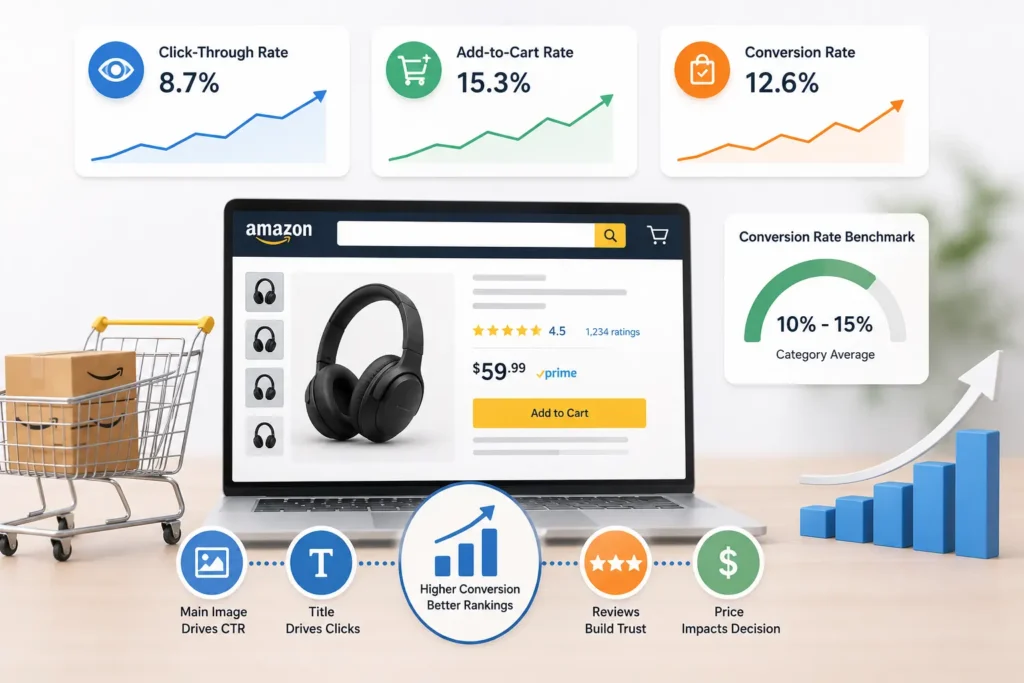
Conversion rate is a direct ranking input: Amazon deprioritises listings that buyers click but don't purchase. Main image and price positioning drive click-through rate more than any other listing element.
Backend Search Terms give you 250 bytes of invisible keyword coverage — most listings leave this field partially empty or filled with duplicates that waste the space.
Sales velocity — how consistently your product sells — is the longest-term ranking factor and the hardest to fake. Targeted PPC on your primary keywords is the most effective bootstrap for new listings.
Cookbeat grew Amazon sales by 25% in 90 days after listing optimisation and account management changes — not from a single fix but from aligning keywords, conversion, and velocity together.
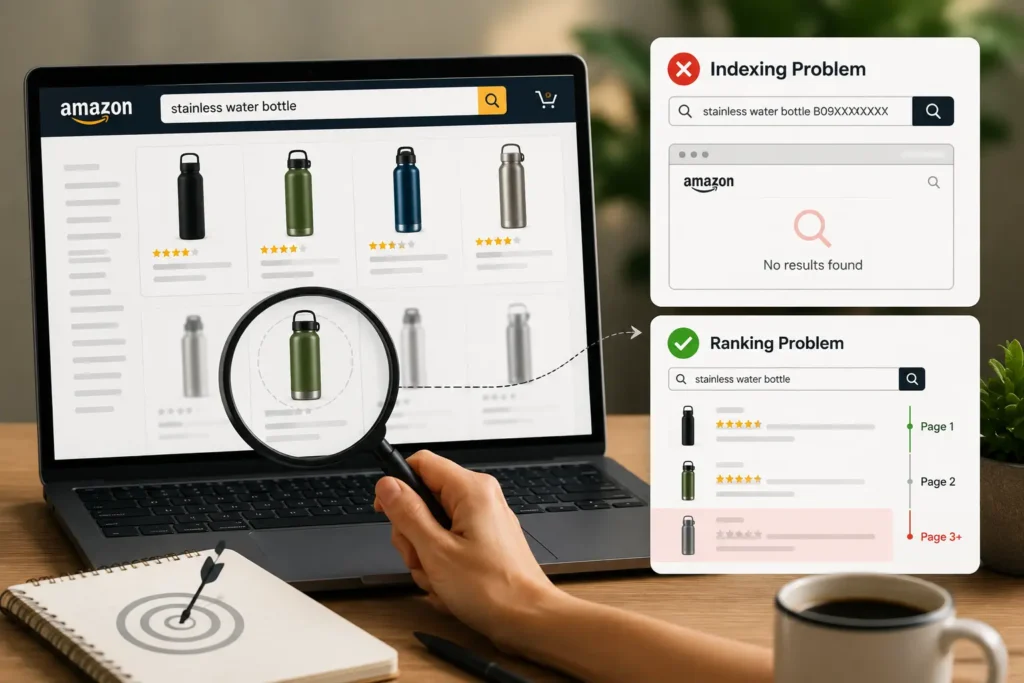
The first is an **indexing problem** — Amazon hasn’t matched your listing to the relevant search terms at all. If a buyer types your exact product category into the search bar and your ASIN doesn’t appear anywhere in the results, Amazon hasn’t indexed that keyword on your listing. You can check this in 60 seconds: search your primary keyword followed by your ASIN directly in Amazon’s search bar (e.g., “stainless water bottle B09XXXXXXXX”). If nothing appears, you have an indexing gap.

Most Amazon ranking problems trace back to one of three causes. They can overlap, but the fixes are distinct.
[ Root Cause 1 ]
Keyword Placement
If your listing doesn’t contain the exact words a buyer typed, Amazon won’t show it in those results. The mistake is common: sellers use brand language, internal product names, or specification terms that don’t match how buyers actually search. A listing titled “premium hydration vessel 750ml” won’t rank for “water bottle for gym” — even if it’s a perfect product match. Amazon is matching text, not intent.
[ Root Cause 2 ]
Weak Conversion Signals
Amazon ranks products that convert after buyers click them — not just products that contain the right keywords. If buyers reach your listing and leave without purchasing, Amazon treats that as evidence the listing isn’t serving the search intent well. Over time, it tests your product lower in the results to allocate impressions to listings that convert better.
[ Root Cause 3 ]
Insufficient Sales Velocity
Amazon gives ranking weight to products with recent, consistent sales. New listings have no purchase history — which puts them at a structural disadvantage against established products that have been selling steadily for months. Low-velocity listings compete against listings with hundreds of accumulated sales signals, and the algorithm reflects that gap in rankings.

Your listing copy is the primary input Amazon uses to determine relevance. Five fields carry most of the weight — and most listings have gaps in at least two of them.
Product Title
The title is the most heavily weighted field in Amazon’s algorithm. Place your primary keyword within the first 80 characters — this is what Amazon indexes most aggressively and what buyers see before clicking. Secondary keywords belong in the second half of the title, after the primary phrase and product type. Keep it readable: Amazon penalises keyword stuffing, and a cluttered title lowers click-through rate, which then hurts ranking. The structure that works: primary keyword + product type + 1–2 key attributes (size, colour, count).
Bullet Points
Bullet points are indexed by Amazon and read by buyers — they do two jobs simultaneously. Use the first two bullets to naturally incorporate your top supporting keywords while addressing the buyer’s primary purchase concerns. Lead with the benefit, not a formatted label like “FEATURE:” — buyers skim bullets for outcomes, not category tags. Use all five available bullets and distribute your keyword list across them without forcing any phrase unnaturally into a sentence.
Backend Search Terms
The Search Terms field in Seller Central is invisible to buyers but fully indexed by Amazon. It’s capped at 250 bytes — use every byte. Include keyword variations, common misspellings, synonyms, and alternate search phrases that didn’t fit naturally in your title or bullet copy. Do not repeat keywords already in your title: Amazon indexes those automatically and repetition wastes your 250 bytes. No commas needed; separate terms with spaces.
A+ Content
A+ Content (available via Amazon Brand Registry) doesn’t directly rank your listing, but it raises your conversion rate — and conversion rate is a ranking input. For brand-registered sellers, A+ Content increases the ceiling on how many visitors become buyers. Higher conversion feeds back into the algorithm’s ranking signals over time. If you’re Brand Registered and not using A+ Content, you’re leaving a conversion improvement on the table that directly influences organic ranking.

Your listing may have an indexing gap — Amazon hasn't matched it to the searched keyword at all — or it's indexed but ranking too far back for buyers to reach. Check by searching your primary keyword + ASIN in Amazon's search bar. If nothing appears, the problem is keyword placement in your title and backend Search Terms. If your product appears but ranks on page 3 or later, the issue is conversion or sales velocity signals.
Amazon ranks products on three main factors: keyword relevance (how well your listing copy matches buyer search terms), conversion performance (click-through rate, add-to-cart rate, and purchase rate), and sales velocity (how recently and consistently your product sells). Most ranking problems trace to a gap in one of these. Keyword placement is the fastest to fix; sales velocity takes the longest to build but has the most durable impact on organic ranking.
Place your primary keyword within the first 80 characters of the title — this is the section Amazon weights most heavily and what buyers see in search results before clicking. Follow it with your product type and 1–2 key attributes such as size, colour, or quantity. Keep it readable: keyword stuffing lowers click-through rate, which hurts ranking. Secondary keywords go in the title's second half, bullet points, and backend Search Terms field.
Keyword and title changes are typically re-indexed by Amazon within 24–72 hours. Actual ranking movement — your product appearing higher in search results — depends on conversion and sales signals, which take days to weeks to accumulate. Structural listing changes such as correct category selection, complete bullet points, and A+ Content influence ranking over a 4–8 week window as Amazon collects updated performance data on the revised listing.
Reviews affect ranking indirectly through conversion rate. A product with a higher review count and stronger star rating converts at a higher rate than a comparable product with few reviews — and that conversion difference is a direct ranking input. Review count alone isn't a ranking signal Amazon explicitly weights, but the buyer trust it generates, which drives click-through and purchase rates, feeds directly back into the algorithm's ranking decisions.
Amazon's A9 algorithm (often referred to as A10 in its current iteration) ranks products by first matching listing content to buyer search queries, then weighting results by conversion and sales history. Products that contain the searched keyword and have a consistent record of converting buyers who click on them rank highest. The algorithm also factors in listing completeness, price competitiveness, fulfilment type — FBA tends to rank above FBM — and overall seller account health.
Yes — keyword optimisation, listing quality improvements, and consistent review accumulation all improve organic ranking without paid spend. For new listings with no sales history, however, organic growth is slow because the algorithm has no performance signal to rank against established competitors. PPC is the most efficient way to bootstrap initial velocity, but it's a starting mechanism — not a permanent requirement. Listings with strong organic conversion rates and steady sales history can hold top rankings with minimal or no ongoing ad spend.