
Local SEO For Pet Business

Jul 13, 2026
12 Min Read
Your Google Business Profile category is the single most influential field in local search — choosing "Pet Store" instead of "Pet Groomer" pushes you into the wrong results entirely.
"Near me" rankings are driven by GBP location data, not website keywords — so for that specific search intent, profile work outweighs new content.
Reviews are a direct Google ranking signal: response activity, review volume, and recency all factor into the Local Pack algorithm — not just star rating.
NAP consistency across Justdial, Sulekha, and IndiaMart is a one-time audit that closes a ranking gap most pet businesses don't know they have.
Each pet business type has a highest-leverage tactic: groomers need photo volume, vets need service-specific schema, sitters need service area precision, and stores need product-level keyword pages.
Local SEO results typically appear within 4–8 weeks for GBP changes and 8–12 weeks for website pages — the businesses holding top rankings treat it as ongoing maintenance, not a one-time setup.
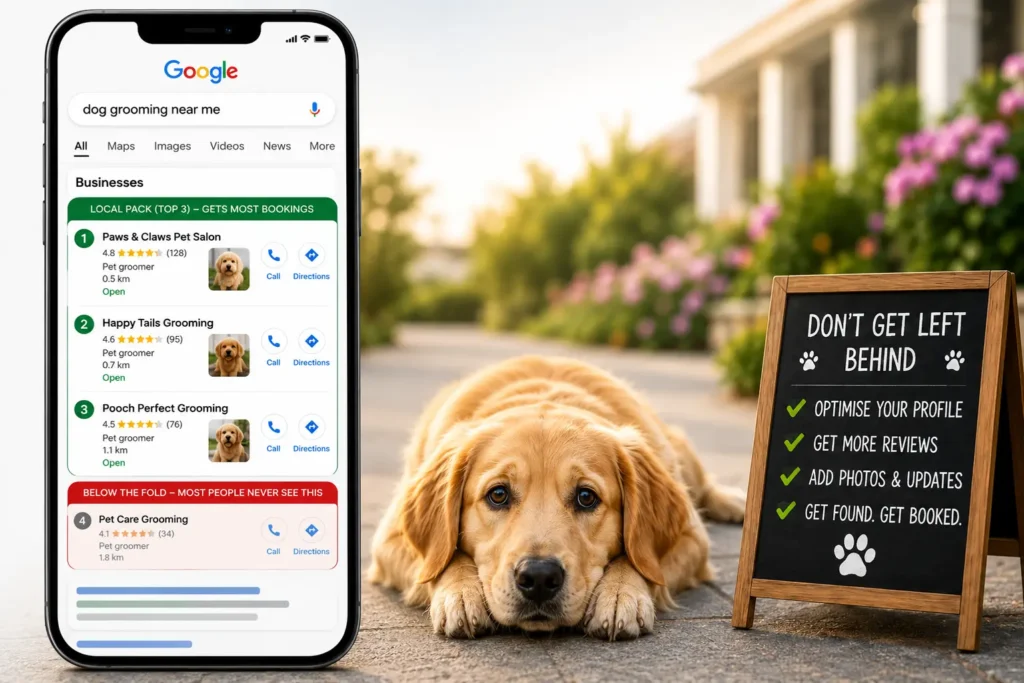
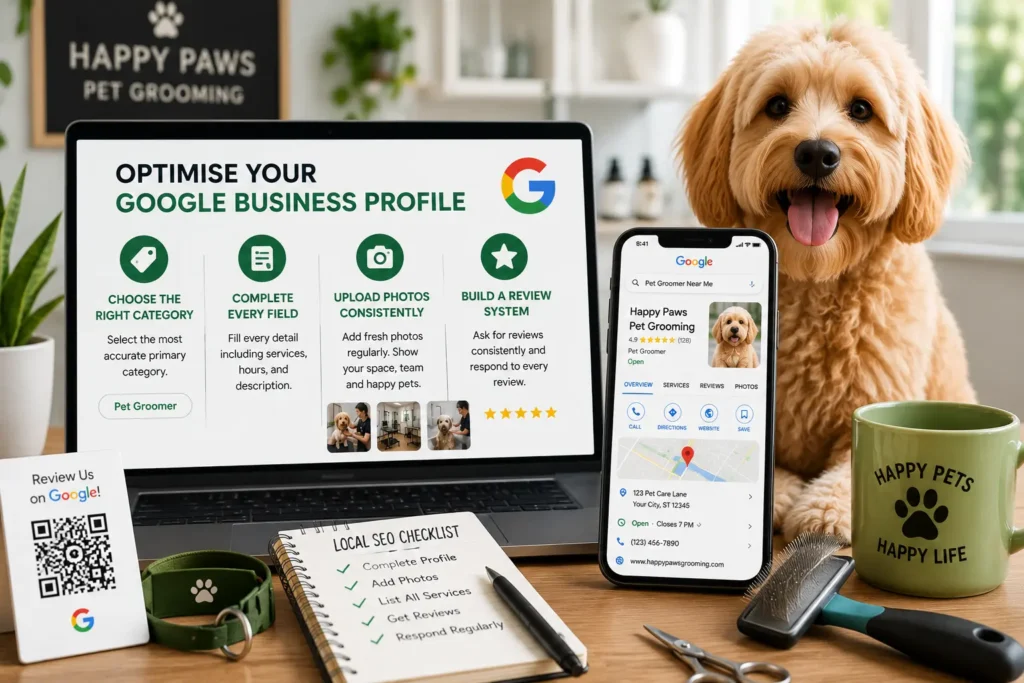
Your Google Business Profile (GBP) is the most important asset in your local SEO strategy — more impactful than your website for local search visibility. It powers what appears in the map pack, Google Maps, and the knowledge panel. Google uses it to decide whether to show you at all in local results.
Choose the Right Primary Category
Your primary category is the most influential field in GBP — it determines which searches you’re eligible to appear in. For a grooming salon, the correct primary category is “Pet Groomer.” For a veterinary clinic, it’s “Veterinarian.” Selecting “Pet Store” as your primary category for a grooming business pushes you into the wrong search results entirely. Add secondary categories for each additional service — “Dog Trainer,” “Pet Boarding” — but keep the primary category precise.
Complete Every Field
Business name, phone, hours, website, description, services — fill every field. GBP descriptions allow 750 characters; use at least 500 and include your primary service and city name naturally within the copy. Add individual service listings with their own descriptions. Where applicable, list price ranges. Google cross-references these fields against search queries to determine relevance.
Upload Photos Consistently
According to Google’s own GBP data, businesses with photos receive significantly more requests for directions and website clicks than those without. For pet businesses specifically, photos do double work: they rank your profile higher and they convert searchers into callers. Upload photos of your space, your team at work, and your results — before-and-after grooming shots are particularly effective. Set a recurring weekly reminder to add 4–5 new images; this signals to Google that the business is active.
Build a Review System — Not a One-Time Ask
Ask every client for a review at the moment of checkout or appointment close. A printed QR code at reception, a WhatsApp message post-visit, or a follow-up SMS all work. What doesn’t work is asking 40 clients in a single week — Google’s algorithm treats sudden volume spikes as suspicious and may filter them. Build a steady pace: 3–5 new reviews per week over time is more valuable than 50 in a day. Respond to every review — positive and negative — within 48 hours. Google tracks response activity as an engagement signal.
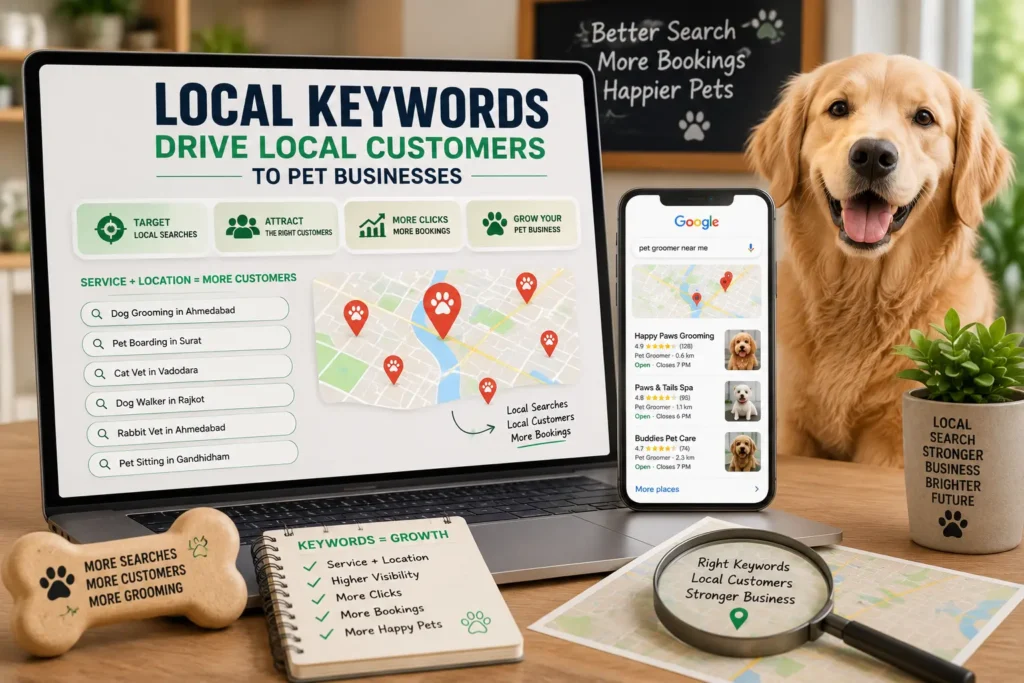
Local SEO is keyword-specific. You’re not competing to rank for “pet grooming” nationally — you’re targeting “pet grooming in Ahmedabad,” “dog groomer near me,” and “cat boarding Surat.” These service + location combinations are where bookings originate.
The basic pattern is straightforward: service + city. “Pet boarding in Vadodara.” “Rabbit vet Ahmedabad.” “Dog walker Rajkot.” Map every service you offer, attach your city name (and nearby localities if relevant), and you have your local keyword list. These phrases belong in your website page titles, your GBP service descriptions, and the first paragraph of each service page.
“Near me” searches work on different mechanics. Google resolves those queries using your GBP location data — not your website content. That means the most impactful thing you can do for “near me” traffic is ensure your GBP address is accurate and consistent across every platform it appears on. This isn’t an SEO trick; it’s how Google’s local algorithm functions.
For your website, build a separate page for each core service. A page titled “Dog Grooming in Ahmedabad” will rank better for that specific phrase than a single homepage trying to cover all services at once. Each page should be 300–500 words, include your city in the title tag and first paragraph, and describe the specific service clearly. This applies to every pet business type — groomers, vets, sitters, and stores.
Reviews as a Ranking Signal
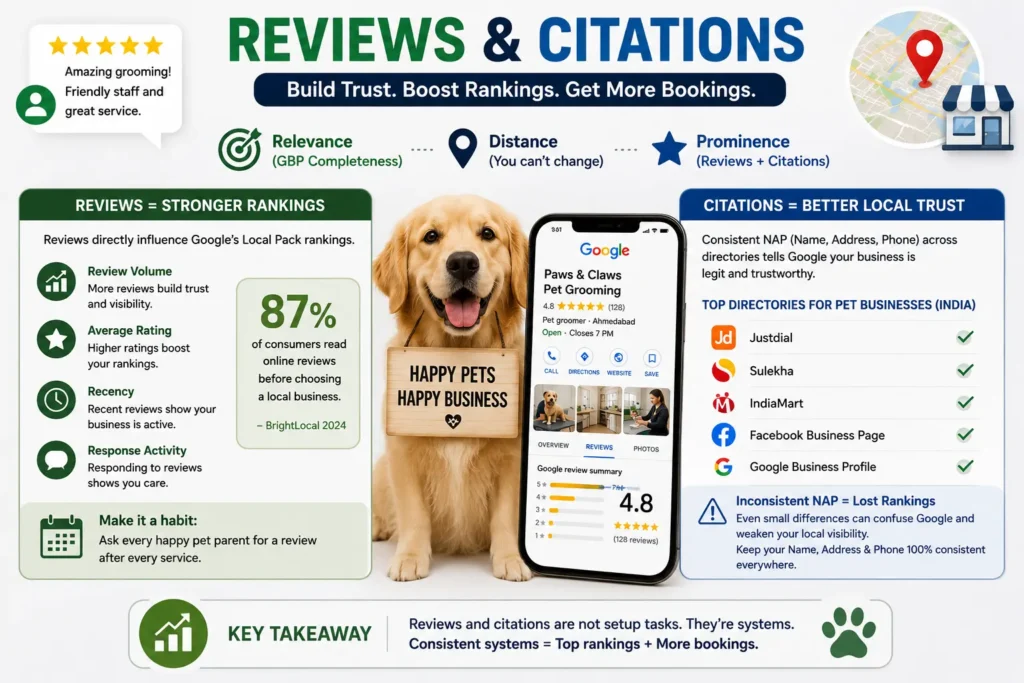
According to BrightLocal’s 2024 Local Consumer Review Survey, 87% of consumers read online reviews before choosing a local business — and review signals directly influence Google’s Local Pack rankings. The factors Google weights are review volume, average rating, recency, and owner response activity. A business with 60 steady reviews over 18 months ranks more reliably than one with 100 reviews collected in a single campaign 2 years ago.
The practical implication: build review collection into your daily operations, not your annual marketing calendar. Every grooming appointment, every vet visit, every overnight board is a review opportunity. The pet businesses holding the top local positions in competitive Indian cities have made this a standard part of their checkout process — not an occasional push.
Citations — NAP Consistency Across Directories
A citation is any listing that shows your business Name, Address, and Phone (NAP) on another platform. For pet businesses in India, the directories that carry the most weight are Justdial, Sulekha, IndiaMart, Facebook Business Page, and Google itself. Consistent NAP data across all of these tells Google your business information is accurate and trustworthy.
The risk is inconsistency. If your phone number is formatted differently on Justdial than on your GBP, or your address uses “Lane” in one listing and “Ln.” in another, Google treats those entries as potentially different businesses and dilutes the ranking signal. Audit your listings on each major directory and make sure every entry matches your GBP exactly — same business name format, same address, same phone number.
Pet Grooming Salons
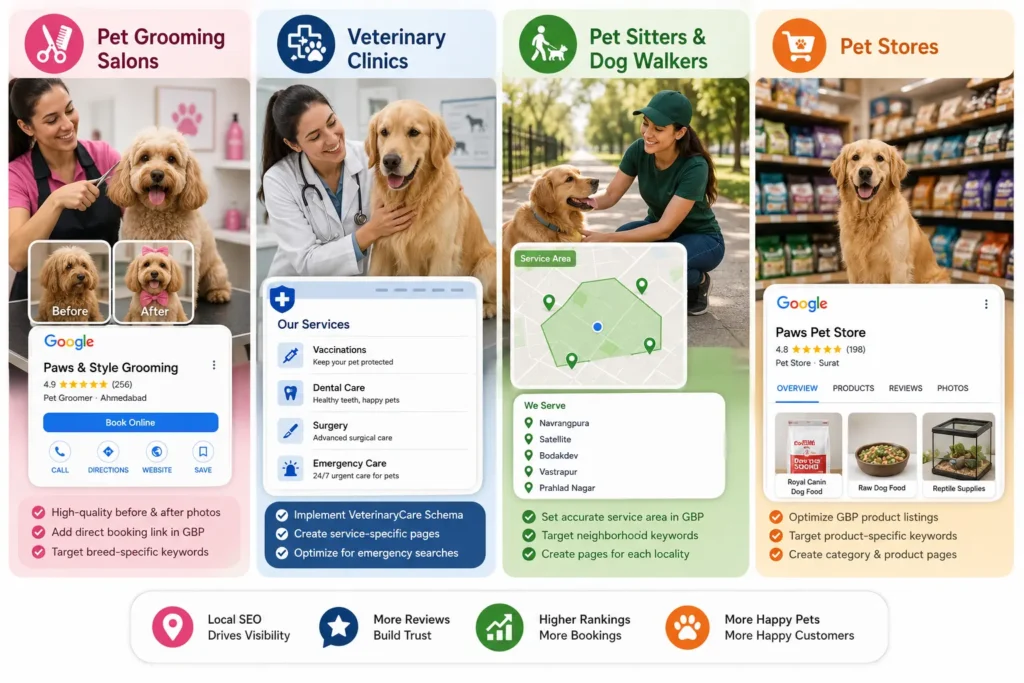
Photos are the highest-leverage element for groomers. Before-and-after grooming shots build trust faster than any written description and keep your GBP activity signals high. Add a direct booking link in your GBP so customers can schedule without leaving Google. For long-tail keyword opportunities, go beyond “pet groomer in [city]” and target breed-specific phrases — “golden retriever grooming Ahmedabad,” “poodle trim Surat” — which attract higher-intent searches with less competition.
Veterinary Clinics
Schema markup matters more for veterinary clinics than any other pet business type. VeterinaryCare schema tells Google’s systems exactly which services your clinic provides, which helps you appear for condition-specific and treatment-specific searches beyond the standard “vet near me” query. Build separate service pages for vaccinations, dental care, surgery, and emergency services — each targeting its own keyword cluster. Emergency vet searches carry high urgency and convert at the highest rate; a dedicated, well-optimised emergency page captures that demand.
Pet Sitters and Dog Walkers
Service area settings in GBP are critical for service-area businesses. Unlike a physical storefront, your work spans multiple neighbourhoods. Set your service area in GBP to match where you actually operate — then go further and target neighbourhood-specific keywords on your website. “Dog walker in Navrangpura” will convert at a higher rate than “dog walker in Ahmedabad” for a customer sitting in Navrangpura. Build pages for each locality you serve.
Pet Stores
Product-specific keywords extend your local SEO surface area significantly. If you stock specific brands or product categories, target those phrases with dedicated product or category pages — “Royal Canin in Ahmedabad,” “raw dog food Surat,” “reptile supplies Vadodara.” GBP product listings allow you to showcase your inventory directly in search results; for pet stores, this is one of the most underused features in local SEO.
This week:
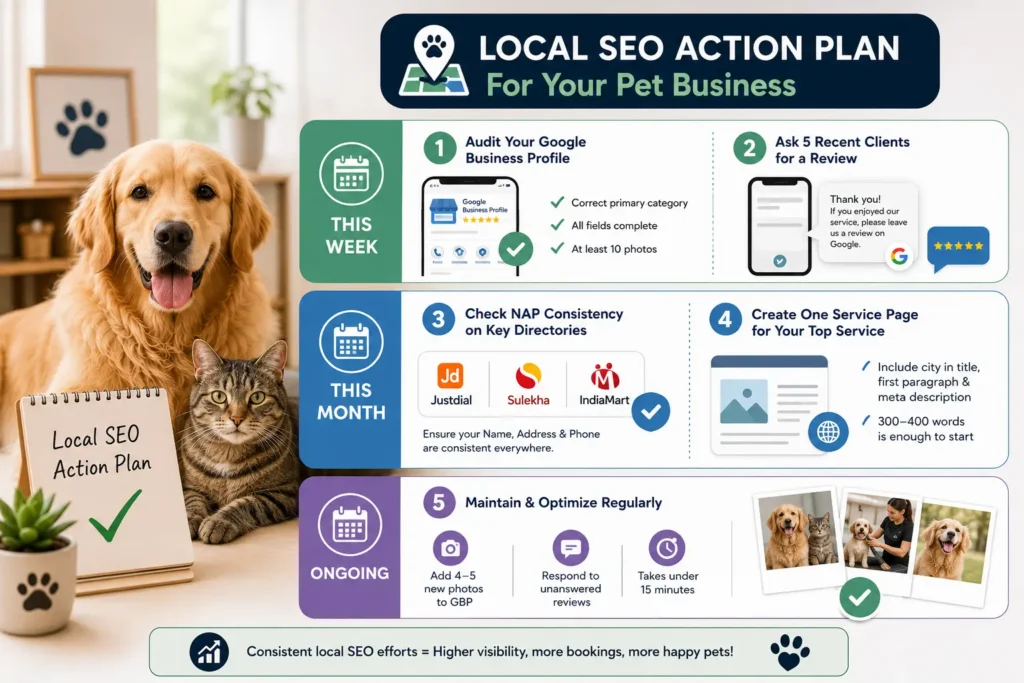
Audit your Google Business Profile. Is your primary category correct? Are all fields complete? Do you have at least 10 photos? This one-hour audit affects every local search you’re eligible to appear in.
This month:
Check NAP consistency on Justdial, Sulekha, and IndiaMart. Search your business name on each and correct any variation in your address format or phone number.
Ongoing
Set a monthly reminder to add 4–5 new photos to GBP and respond to any unanswered reviews. This takes under 15 minutes and keeps your profile signalling as active.
Local SEO is the process of optimising your online presence so your business appears when people nearby search for your services. For pet businesses, this means appearing in Google's Local Pack — the three map listings that show above all other results — when someone searches "pet groomer near me" or "vet in [your city]." Most pet business bookings start with a local search, and the Local Pack captures the majority of those clicks.
Start by selecting the correct primary category — "Pet Groomer" or "Veterinarian," not a generic "Pet Store." Fill every available field: services with individual descriptions, business hours, phone, website link, and business description (use at least 500 of the 750 allowed characters and include your city name naturally). Upload photos weekly. Collect reviews consistently and respond to every one within 48 hours. Profiles that show regular activity rank higher in local results than inactive ones.
Target service + location combinations — "dog grooming in Ahmedabad," "cat vaccination Surat," "pet boarding near me." Build a separate page on your website for each core service and include your city name in the page title, first paragraph, and meta description. For "near me" searches, your GBP location data handles the ranking — which means your most important task for that specific intent is ensuring your GBP address is accurate and consistent across every directory listing.
Reviews are a direct ranking signal in Google's local algorithm. Businesses with higher review volume, better average ratings, more recent reviews, and active owner responses rank higher in the Local Pack. According to BrightLocal, 87% of consumers read reviews before choosing a local business. Ask every client for a review at checkout or via a follow-up message. Respond to all reviews — Google tracks response activity as part of your profile's engagement signals.
A local citation is any listing that shows your business name, address, and phone number (NAP) on another website. For pet businesses in India, the most relevant directories are Justdial, Sulekha, IndiaMart, Facebook Business, and Google itself via GBP. The critical factor is consistency — your NAP must be identical across every listing. A phone number formatted differently across platforms, or an address with slight variations, weakens your local ranking signals by making Google uncertain which listing is authoritative.
GBP optimisation and review collection typically show results within 4–8 weeks. New website pages with targeted keywords take 8–12 weeks to reflect in rankings. Citation building and schema markup compound over a longer timeline. Local SEO is not a one-month project — it's a system that builds on itself. The businesses that rank consistently in the Local Pack are those treating it as ongoing monthly maintenance, not a one-time setup task.
GBP optimisation, review collection, and basic citation management are tasks a pet business owner can handle without outside help — especially in the early stages. What typically requires specialist support is technical SEO (schema markup, site speed, crawl issues) and competitive keyword strategy in larger cities where multiple businesses are actively optimising. Start with what you can implement yourself, measure results at 90 days, then assess whether technical gaps or competitive density warrant outside support.