
SEO Mistakes

Jul 13, 2026
12 Min Read
This post organizes the seo common mistakes most sites carry into four fixable categories — technical, on-page, content, and backlinks — so you can work through them in the order that actually matters.
Technical issues — noindex tags left over from launch, blocked crawl paths, slow Core Web Vitals — stop Google from indexing pages correctly, so no content or link work fixes anything until these are cleared first.
Duplicate or missing title tags and meta descriptions cause keyword cannibalization, where two pages on the same site compete for the same query instead of one page winning it.
Duplicate or missing title tags and meta descriptions cause keyword cannibalization, where two pages on the same site compete for the same query instead of one page winning it.
Low-quality backlinks can actively suppress rankings through Google's link-spam systems, not just fail to help — quality and relevance matter more than volume.
The Shillong Tours grew organic traffic by 50% within six months through Growth Naavik's SEO engagement, largely by rebuilding content around actual search intent rather than just target keywords.

Technical SEO mistakes decide what Google can even see. If a page can’t be crawled or indexed correctly, content quality and backlinks never get the chance to matter.
Noindex tags or robots.txt rules left over from launch
Sites often go live from a staging environment with a noindex tag or a robots.txt disallow rule still in place — settings that were correct for a test site and wrong for a live one. Open Google Search Console’s Page Indexing report and look for “Excluded by noindex tag” or “Blocked by robots.txt” on pages you expect to rank. If key pages show up there, that setting alone can explain flat or falling rankings — remove the rule and request indexing for the affected URLs.
Slow page speed and weak Core Web Vitals
Google confirmed page experience — including Largest Contentful Paint, Interaction to Next Paint, and Cumulative Layout Shift — as a ranking input, and slow pages also lose visitors before they finish loading. Run your key pages through PageSpeed Insights and note which metric fails first; it’s usually image weight or unused JavaScript. Compressing images and deferring non-critical scripts fixes most of it without a redesign.
A site that isn’t built mobile-first
Google indexes the mobile version of your site as the primary version, so a mobile experience that hides content, shrinks text, or loads slowly caps what Google can index at all — regardless of how the desktop version looks. Check the Mobile Usability report in Search Console for flagged issues. A site that passes on desktop can still fail here.
Broken links and orphaned pages
Broken internal links waste crawl budget and send visitors to dead ends. Orphaned pages — pages with no internal links pointing to them from anywhere else on the site — are harder for Google to find and rarely rank well no matter how strong the content is. A crawl tool like Screaming Frog surfaces both issues in one pass; fix the 404s and link to orphan pages from at least one relevant page.
Missing meta descriptions and duplicate title tags
Missing meta descriptions mean Google writes its own snippet, which rarely matches what actually earns a click. Duplicate title tags across multiple pages create keyword cannibalization — two pages compete for the same query instead of one page winning it outright. Check Search Console’s Pages report, sort by similar queries, and confirm each page targets a distinct primary term.
Keyword stuffing instead of natural placement
Repeating an exact-match keyword throughout a page used to help rankings; today it makes content harder to read and can trigger Google’s over-optimization filters. Place the primary keyword in the title, one H2, and the opening paragraph, then write the rest using natural variations and related terms.
Weak or missing heading structure
Multiple H1 tags on one page, or headings that don’t reflect what the section actually covers, make it harder for both Google and readers to understand the page’s structure. Every page should have exactly one H1, followed by H2s and H3s that mirror the actual content outline — not a random visual hierarchy.
Missing alt text on images
Alt text tells Google what an image contains, contributes to overall page accessibility, and is the entry point for image search traffic. Write alt text that describes what’s actually in the image, including the target keyword only where it fits naturally — not stuffed in every image on the page.

Writing for the keyword instead of what the searcher wants
A search for “best desk lamps” wants product options, not a history of desk lamp design. When a page answers a different question than the one behind the keyword, that’s a search intent mismatch, and Google won’t rank it well regardless of how polished the writing is. Search the target keyword yourself and look at what’s already ranking — the format and angle of the top five results tells you what searchers are actually looking for.
Thin or generic content that repeats what’s already ranking
A shorter, less specific version of a page that already ranks gives Google no reason to rank yours above it. The fix isn’t length for its own sake — it’s including a detail, example, or data point the top-ranking pages don’t already cover.
No content refresh cycle
Rankings decay as competitors update their pages and your data, examples, and screenshots go stale. A page published once and never revisited loses relevance gradually, then noticeably. Reviewing your highest-traffic pages once a quarter and updating anything outdated keeps that decay from compounding.
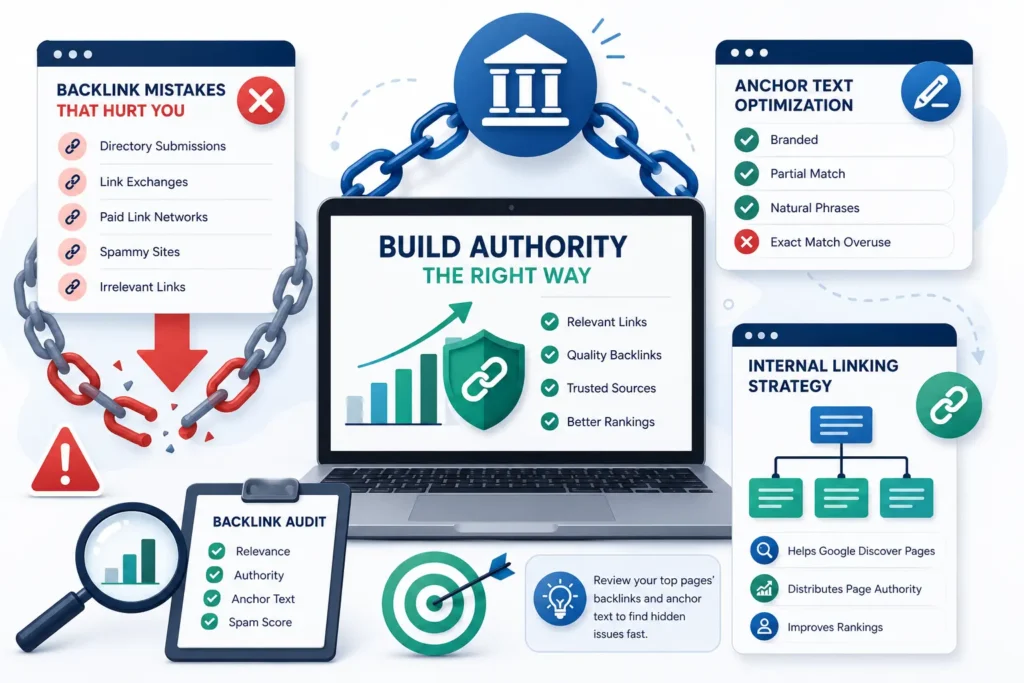
Chasing backlink volume instead of relevance
A large number of low-quality backlinks — directory submissions, link exchanges, paid link networks — can trigger Google’s link-spam systems and suppress rankings rather than lift them. A handful of links from sites relevant to your industry outperforms hundreds of unrelated ones. Check your backlink profile in Search Console or a third-party tool and disavow anything clearly spammy or unrelated to your business.
Skipping anchor text optimization
Anchor text optimization isn’t about repeating your exact-match keyword on every link — doing that looks manipulative to Google’s algorithms, and generic anchors like “click here” waste a chance to signal what the linked page is about. A natural anchor text profile mixes branded terms, partial matches, and plain phrases — not one repeated exact-match phrase.
No internal linking strategy
Pages with no internal links pointing to them are harder for Google to discover and rank, and internal links are one of the few ranking signals fully within your control. New content should link to relevant existing pages, and older high-authority pages should link back to newer, related ones.

This week — Technical
This week — On-page
Ongoing — Backlinks
The most common mistakes fall into four categories: technical errors (noindex tags, slow speed, broken links), on-page gaps (missing meta descriptions, keyword stuffing), content issues (search intent mismatch, thin content), and backlink problems (low-quality backlinks, poor anchor text). This list of seo mistakes to avoid works best checked in that order — technical first, backlinks last.
If you've been searching "why my website is not ranking" without a clear answer, start with a Search Console indexing check before touching content or links. Active SEO work doesn't fix mistakes it wasn't designed to catch — a leftover noindex tag or the wrong search intent can undo months of otherwise correct optimization.
The most frequent on-page mistakes are missing or duplicate title tags and meta descriptions, keyword stuffing instead of natural placement, multiple or missing H1 tags, and images without alt text. Each one is fixable directly in the CMS without developer involvement, which makes this category the fastest to clear once identified.
The most damaging technical seo mistakes are noindex tags or robots.txt rules left over from a site launch, slow page speed and weak Core Web Vitals, a site that isn't built mobile-first, and broken links leading to orphaned pages. These block Google from crawling or indexing pages correctly, which caps everything else on the site.
A large volume of low-quality backlinks, irrelevant directories, or spammy link networks can trigger Google's link-spam detection systems, which actively suppresses rankings rather than simply failing to help them. Backlink quality and relevance to your industry matter more than raw quantity — a handful of relevant links outperforms hundreds of unrelated ones.
When a page answers a different question than the one behind the search query, Google won't rank it well regardless of writing quality or keyword placement, because Google evaluates whether a page satisfies what the searcher actually wanted. Checking what already ranks for a target keyword reveals the intent your page needs to match.
Technical and on-page checks are worth running quarterly at minimum, and immediately after any ranking drop or major site change. Content should be reviewed for accuracy and depth every quarter on your highest-traffic pages, while backlink profiles are worth checking monthly since spammy links can appear without any action on your part.