
SEO Metadata Block

Jul 29, 2026
12 Min Read
SEO runs on three continuous processes crawling, indexing, and ranking not a single setup step, and a site can fail at any one of the three.
Crawling only discovers a page; it's indexing that decides whether that page is even eligible to appear in search results at all.
Crawling only discovers a page; it's indexing that decides whether that page is even eligible to appear in search results at all.
This search engine optimization process runs on a loop: search engines recrawl and re-rank pages continuously as content, competitors, and algorithms change.
A site owner controls three levers inside this process on-page, technical, and off-page SEO each tied to a different stage of how search engines rank websites.
Understanding how seo helps websites rank explains why some pages rank with little visible "SEO work" and others don't rank despite plenty of it the gap usually traces back to one of the three stages.
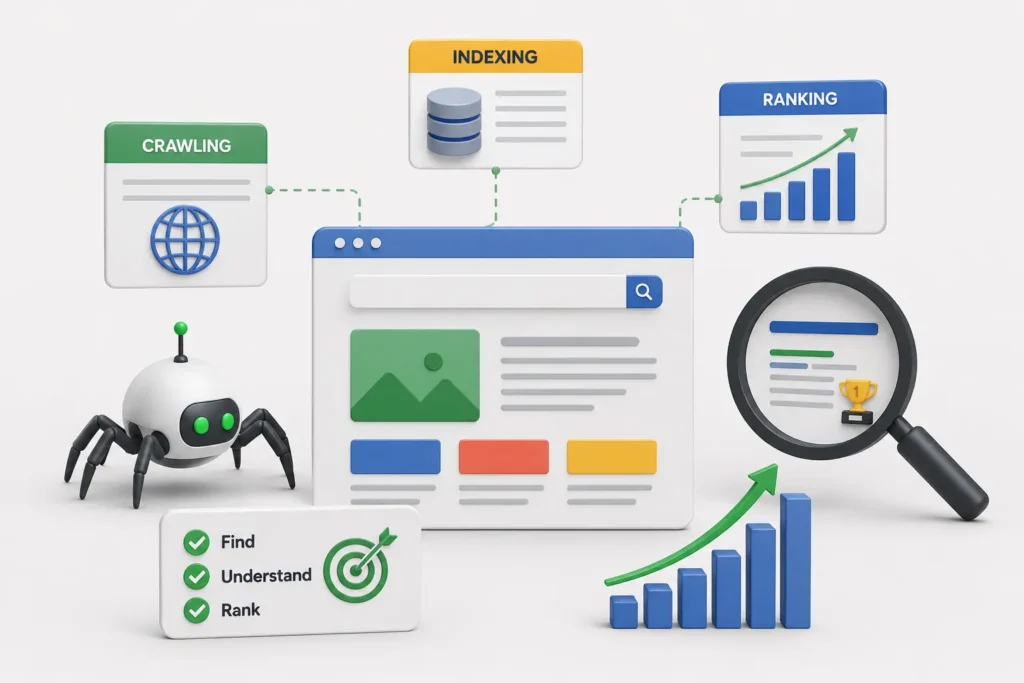
What is seo and how it works starts with one distinction: SEO isn’t a single action, it’s the ongoing work of helping search engines find, understand, and confidently rank a page for the searches it deserves to win.
That’s different from paid search, where a placement is bought directly. SEO earns placement by satisfying the same process search engines run on every page on the internet the one this post walks through next.
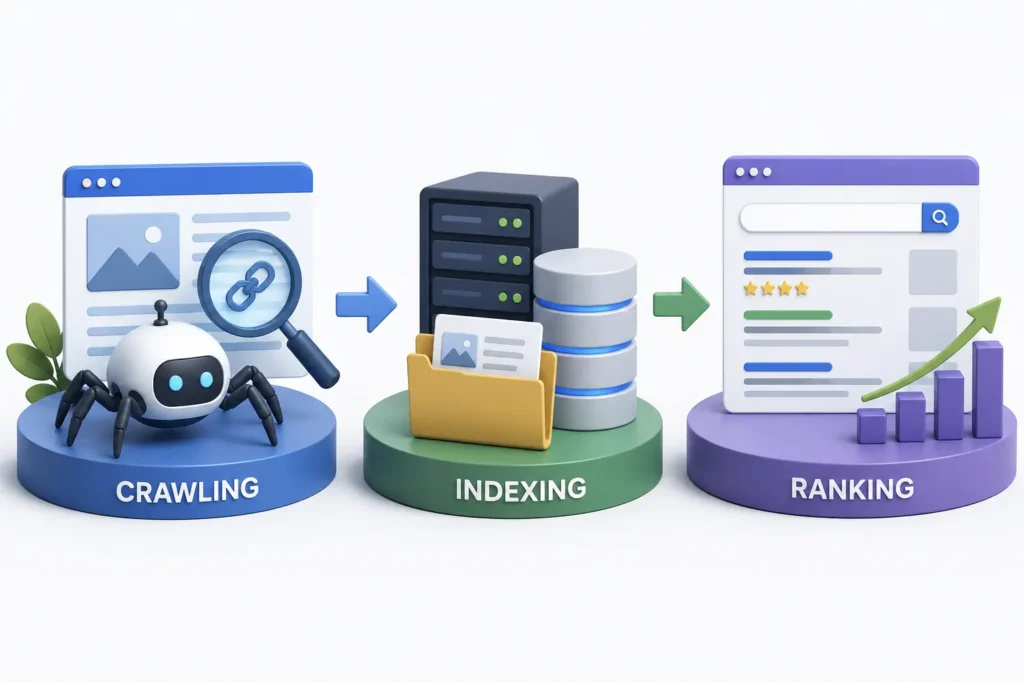
The search engine optimization process runs in three stages, in this order, for every page on the web that ends up in search results.
Once crawled, a page gets analyzed and if it qualifies added to the index: a massive database of pages eligible to appear in search results. A page can be crawled and still not indexed, usually because it’s flagged as duplicate, thin, or blocked by a noindex tag or robots.txt rule.
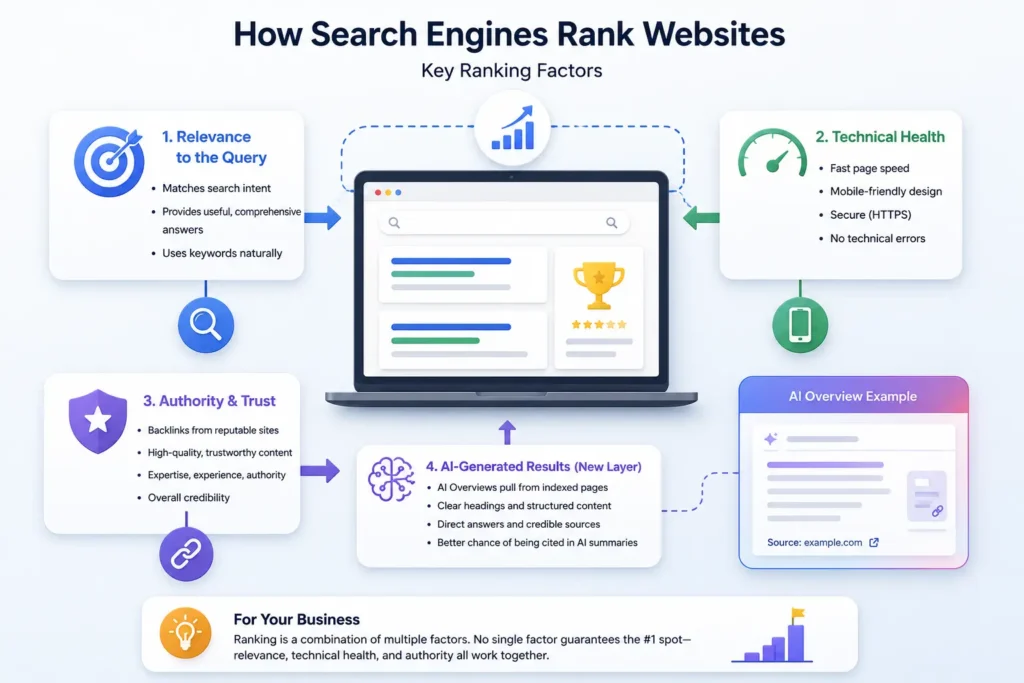
How search engines rank websites comes down to three categories of signal, evaluated together rather than in isolation.
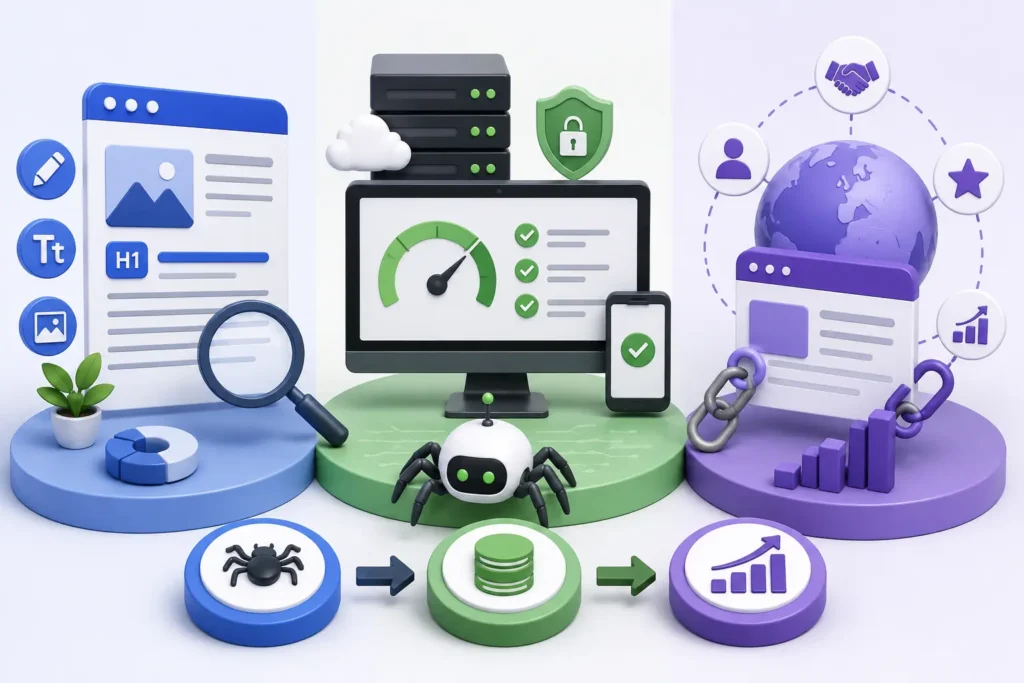
Each stage above maps to a lever a site owner can actually work on this isn’t a full breakdown of SEO types, just how each lever ties back to the process.
On-page SEO—content, titles, and headings—makes a page relevant enough to satisfy search intent. Technical SEO—including site speed, crawlability, and mobile performance—helps ensure pages are crawled and indexed efficiently. Off-page SEO—backlinks and authority signals—builds trust and credibility once a page is competing for rankings. Together, these form the foundation of effective SEO Services.
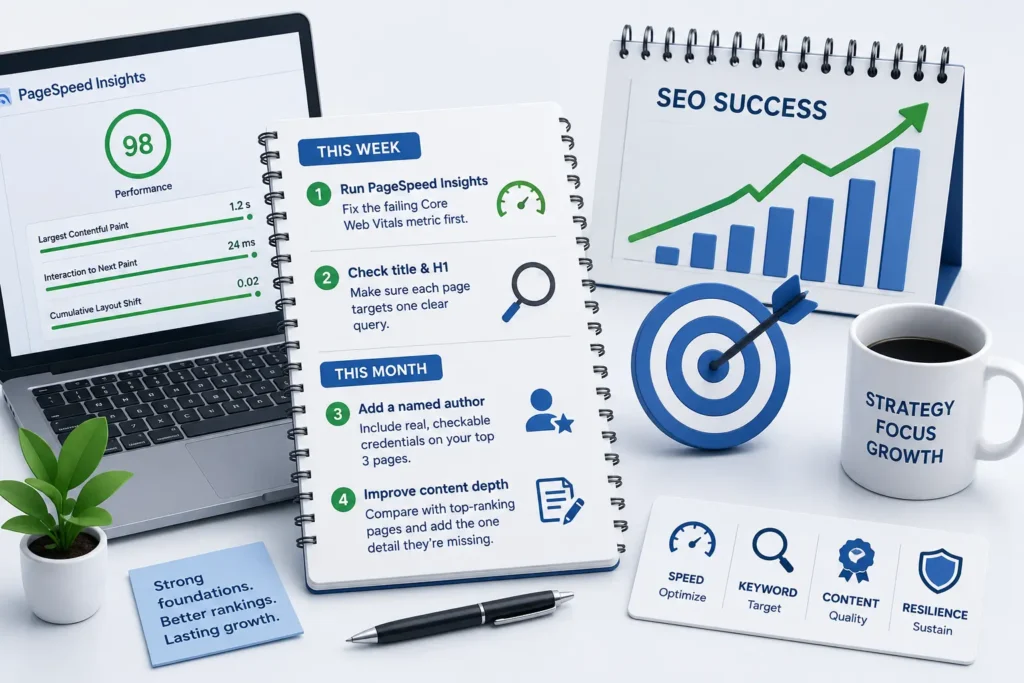
None of this requires re-learning SEO from scratch. It’s a lens for diagnosing where a site is actually stuck crawling, indexing, or ranking instead of guessing.
SEO is the ongoing work of helping search engines find, understand, and rank a page for relevant searches it works through three continuous stages: crawling (discovering pages), indexing (storing and evaluating them), and ranking (ordering them against competing pages for a given search).
Crawling is how a search engine discovers a page by following links. Indexing is whether that page gets stored in the engine's database as eligible to appear in results. Ranking is the ordering step only indexed pages compete, and ranking position depends on relevance, technical health, and authority signals.
Search engines evaluate relevance to the search query, technical health (speed, mobile usability, security), and authority signals like backlinks and content credibility together, not in isolation. A page can be strong on one factor and still lose to a competitor that's better balanced across all three.
The core process crawl, index, rank is common across Google, Bing, and other engines, though each uses its own algorithm and weighting for ranking factors. Google dominates most markets, which is why SEO advice is usually written around its specific systems, but the underlying mechanism is largely the same.
Indexing can happen within hours for a well-linked page on an established site, or take several weeks for a new site with few internal or external links pointing to it. Submitting a sitemap and requesting indexing through Search Console typically speeds up the process.
Backlinks act as a trust signal in the ranking stage a link from a credible, relevant site tells the search engine that other sources vouch for a page's content. They don't affect crawling or indexing directly, but a page with no links pointing to it is also harder to discover in the first place.
Yes, occasionally a page can rank if it happens to be well-structured, fast, and naturally linked to, even without deliberate optimization. This is uncommon and unreliable at scale, though, since none of the three stages are being actively managed, which usually catches up with a site once competitors start optimizing deliberately.
SEO Strategist - Growth Naavik