
Key Takeaways:
- Google traffic shows that your pages matched queries typed into Google; it does not show whether a business is named when someone asks ChatGPT for options.
- OpenAI documents that ChatGPT may choose to search the web and may share search queries with Bing, but it does not document any link between Google rankings and ChatGPT answers, so test your own pages instead of trusting either claim.
- Turning your top ten Search Console pages into buyer questions and running them in ChatGPT gives you ten rows of evidence in about an hour.
- Every row lands in one of four outcomes: no business named at all, businesses named but not you, your page cited but not your brand, or no sources shown.
- Informational pages often earn Google traffic from questions where ChatGPT names no business, which is not a visibility failure and needs no fix.
- Falcon Pumps reported a 586% increase in traffic from generative AI sources, which shows AI-sourced traffic is its own number that can be tracked alongside Google traffic.
What Does Google Traffic Actually Tell You About ChatGPT?
Google traffic tells you that pages on your site matched queries people typed into Google. It does not tell you whether a business is named when someone asks ChatGPT for options. Those are two different outcomes.
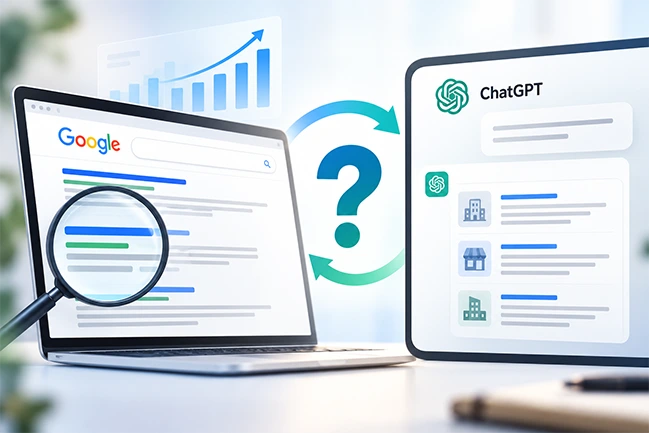
Google traffic vs AI visibility differs in three ways. The unit is different: Google ranks pages, while a ChatGPT answer about options names businesses. The input is different: Google gets a short typed query, while ChatGPT gets a full question.
Context changes the result as well. A Google query such as “warehouse cleaning pricing” is a few words. A ChatGPT question usually adds a location, a size, or a constraint, which narrows the set of businesses that fit.
The output is different too. Google returns a list of links, and ChatGPT writes an answer. These search visibility differences explain why a strong page can sit behind a missing brand mention.
OpenAI’s help page says ChatGPT “may choose to search the web based on what you ask.” It also says ChatGPT may share search queries with the Bing search engine. It does not say that Google rankings feed ChatGPT answers.
That gap matters. Some articles claim ChatGPT ignores Google rankings, and others claim it leans on them. OpenAI documents neither, so treat both as unproven and test your own site.
Owners usually notice this gap in one of two ways. They see Google rankings but no ChatGPT mentions for the same topic, or a buyer reports a website not appearing in ChatGPT when asked for providers. Both observations are real, and neither one points to a single cause.
Organic search performance is still worth protecting. It is simply not evidence about ChatGPT. Organic search visibility in AI answers has to be tested directly, one question at a time.
For your business, this means your Google traffic is the start of the investigation, not the conclusion. The next section turns it into a test.
How Do You Map Your Google Pages to the Questions Buyers Ask ChatGPT?
You already own the data for this. Search Console shows which pages earn clicks and which queries bring them.
Export your top 10 pages by clicks for the last three months, along with the main queries for each. Mark each query as informational or commercial. Queries such as “how to” and “what is” are informational, while queries that name a service, a category, or a comparison show buying intent.
Then turn each page into the question a buyer would ask ChatGPT. For example, a page ranking for “how often should a warehouse be cleaned” might map to “who provides warehouse cleaning services”.
The question must fit what your business actually sells. A cleaning company would not test a question about office renovations, even if a page ranks for it.
Run each question in ChatGPT without your brand name. Record whether any business is named, whether you are named, and which sources it shows. OpenAI’s help page says responses that search can include inline citations and a Sources list.
Keep the log simple. Use one row per question, with columns for the page, the question asked, the businesses named, whether you were named, and the sources shown. A spreadsheet is enough.
Write the question the way a buyer would, not the way your page title reads. A buyer asks “who can clean a 40,000 square foot warehouse near me”, not “commercial warehouse cleaning services”. If your page title and the buyer’s wording differ a lot, test both versions.
Run each question twice, because answers can vary between runs. For a larger set and a logging routine, the setup is covered in How to Measure Your Brand’s Visibility Across AI Search Platforms.
For your business, this means ten rows of evidence replace a guess. Each row pairs a page that works on Google with a question ChatGPT may answer without you.
What Do Your Test Results Say?
Your rows will fall into four outcomes, and each has a different next step. Sort them before you change anything.
ChatGPT answers without naming any business. This is common when your page ranks for an informational query. Your Google traffic comes from a question type where recommendations do not arise. It is not a visibility failure, and it needs no fix.
ChatGPT names businesses, but not you, and the sources shown are third-party pages. This is a coverage gap. AI source selection for this question points to pages you do not control, and those pages name your competitors. The fix is coverage on those sources, not a rewrite of your own page.
ChatGPT cites your page but does not name or describe your brand. This is a brand entity signals gap. The content was used, but nothing tied it to your business clearly. State who you are in plain text on the page, and keep your name and description consistent everywhere.
No sources are shown. The answer came from what the model already holds, so there is nothing to open. Mark these rows separately and re-test them after you have fixed the others.
Do not average the four outcomes into one score. A score hides which fix applies, and the fixes differ in cost and time.
A short example shows how the sort works. Suppose six of your ten rows name no business, three name competitors from third-party list pages, and one cites your page without naming you. Your largest group is informational traffic, so the commercial gap is the three competitor rows, and those come first.
One more pattern needs its own check. Your page ranks for the topic, ChatGPT shows sources, and your page is never among them.
For your business, this means “no ChatGPT visibility” is four different problems. Sort the rows first, then fix the outcome that appears most often.
Can ChatGPT’s Search Reach Your Pages?
Content discoverability has a technical layer that Google traffic cannot confirm. OpenAI’s crawler page says OAI-SearchBot “is used to surface websites in search results in ChatGPT’s search features,” and recommends allowing it in your robots.txt file.
If you opt out, OpenAI says your site “will not be shown in ChatGPT search answers.” GPTBot is a separate crawler for content that may be used in training. OpenAI says each setting is independent of the others, so check which rule you actually wrote.
Also check that the pages themselves can be fetched. Confirm each top page returns a normal response, carries no noindex tag, and sits outside a login wall. Review your firewall or CDN rules too, because a security setting can block a crawler even when robots.txt allows it.
If you can read your server logs, search the last month for the OAI-SearchBot user agent. Requests suggest access works. No requests do not prove a block, but they tell you to review robots.txt and firewall rules first.
Then check Bing. OpenAI says ChatGPT may share search queries with the Bing search engine. It does not say Bing indexing causes a mention, so treat the check as a precaution, not a guarantee.
Being indexed in Google does not show that a page is indexed in Bing. Bing Webmaster Tools includes a URL Inspection tool for checking specific pages. Start with the pages on your top-ten list.
Website discoverability in LLMs depends on more than access. Access is the part you can check in an afternoon. A page that cannot be fetched cannot be shown.
For your business, this means two checks, one robots.txt line and one Bing inspection, can rule out the cheapest causes. Do them before you spend on anything else.
Which Fix Should You Make First?
Website traffic but no ChatGPT visibility has no single fix, so start with the outcome that appears most often in your rows. If most rows show no business named, your Google traffic is mostly informational. AI SEO work then starts with building pages and coverage for the commercial questions your buyers ask.
If most rows show businesses named but not you, work on coverage across the sources ChatGPT shows. If most show your page cited without your brand, fix brand entity signals on the page. If most show no sources, work on consistent coverage across the web and re-test later.
Pages that earn traffic but sit outside what you sell are a separate decision. They can stay as they are. Judge them by Google traffic, and judge your commercial pages by the ChatGPT test.
Do the access checks first in every case? They take an afternoon, and every other fix depends on them.
AI-sourced traffic is a separate channel, and it can be measured and moved on its own. Falcon Pumps, an industrial pump manufacturer, reported a 586% increase in traffic from generative AI sources after an AI SEO engagement. That figure is AI-sourced traffic measured as its own number, not blended into a general organic total.
Track AI-sourced traffic as its own segment in your analytics, and keep Google organic as a separate line. Two numbers tell you more than one blended number.
Avoid two common detours. Rewriting your best-ranking pages rarely helps when the real gap is coverage on other sites. Publishing more articles on the same informational topics adds Google traffic, not recommendations.
Give each change time before judging it. OpenAI says robots.txt changes take about 24 hours to be reflected for search. Changes to coverage on other sites take longer, so re-test after a few weeks, not the next morning.
Nothing here guarantees a mention. Re-run the same ten questions after each change, using identical wording, and compare the rows.
For your business, this means you fix one outcome at a time and measure each channel separately. That is how you tell whether a change worked.
What to Do Next
Set aside one afternoon, then repeat the test after each change:
- Export your top 10 pages by clicks from Search Console, with their main queries.
- Mark each query as informational or commercial.
- Turn each page into a buyer question that fits what your business sells.
- Run each question in ChatGPT without your brand name. Record the businesses named, whether you are named, and the sources shown.
- Sort the rows into the four outcomes.
- Check your robots.txt for OAI-SearchBot, and inspect your top pages in Bing Webmaster Tools.
- Fix the outcome that appears most often, then re-run the same questions.