

Key Takeaways:
- Brand mentions AI search systems pick up on don’t need a link back to count an AI engine reads a mention the same way it reads any other piece of text about your brand.
- Unlinked brand mentions carry real weight because AI systems build brand entity signals from the text and context around your name, not from link equity.
- How much a mention counts depends on three things: how often it happens, how recently, and how much genuine context surrounds it.
- Brand mentions differ mechanically from backlinks and from formal citations they’re evaluated on different signals entirely, not a weaker version of either.
- Consistency across independent, third party references build brand authority signals that no single mention, however well-written, can build alone.
- This is one piece of a bigger mechanism how AI search engines weigh brand mentions alongside the other signals that determine which brands get recommended.
What Counts as a Brand Mention to an AI Search System
A brand mention is any place your brand name appears in text an AI system can read, whether or not it links anywhere. That includes a direct name-drop in an article, a comparison table listing your brand alongside competitors, or a passing reference inside a forum thread.
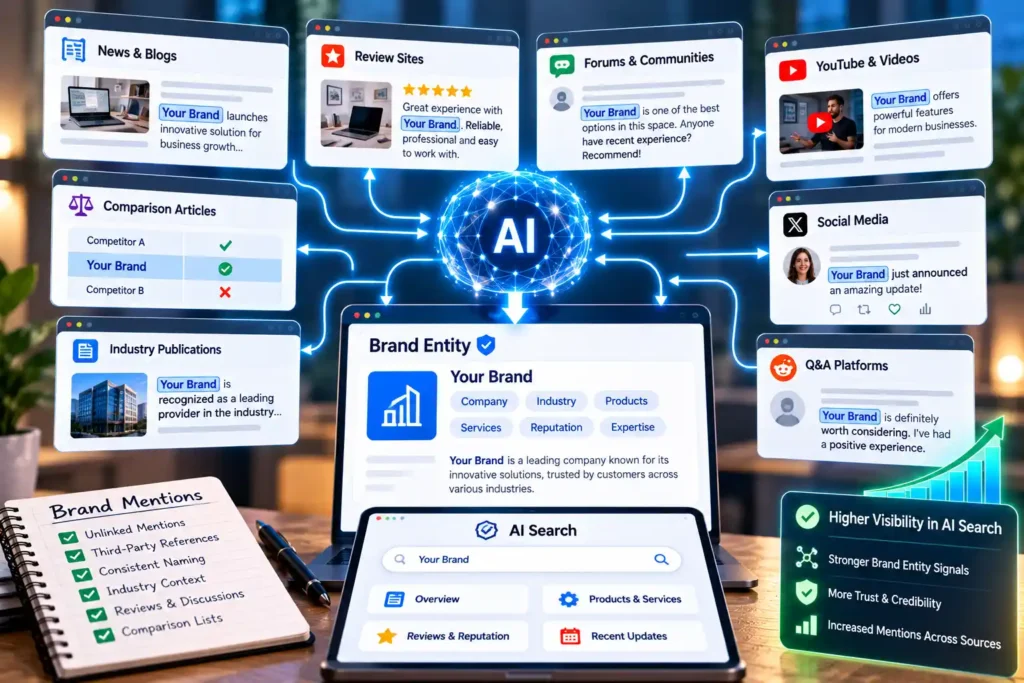
Third party references matter more than mentions you control yourself, since AI systems weigh independent sources differently than brand-published content. A mention on a review site or in an industry roundup carries more signal than the same claim made on your own website.
These mentions feed directly into brand entity signals the accumulated context an AI system uses to understand what your brand is, what it does, and how credible it is as a source. Every mention adds a small piece to that picture.
Consistency matters here too. A brand referred to the same way across multiple independent sources same name, same category, same core description resolves into a single, clear entity far more easily than one referred to inconsistently across different mentions.
For your business, this means monitoring mentions matters even when nobody links to you, because the AI system reading those mentions doesn’t need a link to notice you exist. It also means checking how consistently your brand gets described, not just how often it’s mentioned.
Why Unlinked Mentions Carry Real Weight, Even Without a Link Back
Traditional SEO trained most marketers to treat unlinked mentions as a missed opportunity worth following up to request a link. AI search brand mentions don’t work the same way, because the systems reading them aren’t primarily following link paths to discover content. Unlinked brand mentions AI systems come across get ready for what they actually say about your brand, not for whether they happen to link anywhere.
An AI system building a response reads the surrounding text of a mention directly. It can extract that a review site called your product reliable, or that an industry blog named you among the top three options in your category, without ever needing to click through to your site.
This creates entity association signals connections between your brand and specific topics, qualities, or use cases that get reinforced every time a similar mention appears elsewhere. A brand mentioned repeatedly in the same context builds a stronger association than one mentioned once with a link.
Sentiment plays into this too, even if it’s a lighter factor than context and consistency. A mention framed positively or neutrally reinforces an association more cleanly than one surrounded by complaints, so what a mention actually says still matters more than whether it exists at all.
For your business, this means unlinked mentions from credible, independent sources are worth actively earning, not just noticing after the fact a mention with zero link value in the old SEO sense can still carry meaningful signal here. Tracking sentiment alongside volume gives a clearer read on whether your mention strategy is actually working.
Frequency, Recency, and Context: What Determines How Much a Mention Counts
Not every mention counts equally. Frequency is the first factor a brand mentioned across a dozen independent sources builds a stronger signal than one mentioned once, even if that single mention comes from a highly authoritative source.
Recency matters because AI systems favor content that reflects current information over content that’s gone stale. A glowing mention from three years ago carries less weight today than a comparable mention from the last few months, especially in categories where offerings change quickly.
Context is the factor most people underestimate. A mention buried in a long list with no explanation contributes less than a mention with a sentence or two of genuine context around it what the brand does, why it was mentioned, what makes it relevant to the topic at hand.
These three factors work together rather than independently. A recent, highly contextual mention from a single source can outweigh a dozen old, listicle-style mentions with no real explanation attached volume alone was never the whole picture.
For your business, this means a strategy built purely around mention volume misses two-thirds of what actually matters. Online reputation signals compound faster when mentions are recent and genuinely contextual, not just frequent.
How Brand Mentions Differ from Backlinks and from Formal Citations
A backlink passes a specific, measurable kind of authority through a hyperlink it’s a technical signal with a clear mechanism behind it. A brand mention carries no such technical mechanism; its value comes entirely from the text itself and where that text appears.
A formal citation the kind covered in getting your website cited in AI-generated answers is closer to a mention with a link and a direct reference to your content. Citations tend to carry more weight than plain mentions because they point an AI system directly to a specific, checkable source.
Measuring the three also looks different in practice. Backlink tracking tools won’t catch most mentions at all, since there’s no link to crawl mention tracking needs a separate process built around name-search and monitoring tools rather than the link-focused tools most SEO teams already use.
Brand authority in AI search builds through all three working together: mentions build broad recognition, citations build specific credibility, and backlinks still matter for traditional search rankings that AI systems sometimes draw on as a secondary signal. None of the three substitutes for the other two.
For your business, this means treating mentions, citations, and backlinks as three separate goals rather than one undifferentiated “get more links” strategy. Online brand mentions AI systems pick up on are worth pursuing even where a citation or backlink isn’t realistically available.
Where This Fits into the Bigger Picture
Brand mentions are one signal among several that determine how AI search engines choose which brands to recommend alongside source authority, contextual relevance, and the other factors that shape a recommendation. Mentions build the foundation those other signals draw on.
Brand mentions and AI visibility are connected, but mentions alone rarely explain a strong or weak result on their own. A brand with excellent mention volume but weak topical relevance elsewhere in its content still won’t get recommended reliably.
Treating mentions as an isolated checklist item, separate from everything else that shapes a recommendation, is the same mistake many broad “ranking factor” explainers make the signals interact, and mentions are the piece that feeds the others rather than a standalone lever.
For your business, this means mentions are worth building deliberately, but as one piece of a coordinated approach rather than the entire strategy which is exactly why they’re worth understanding on their own before folding them into anything broader.
What to Do Next
Start by finding out where your brand already gets mentioned a mention-tracking tool or a simple search for your brand name alongside your category will surface most of what’s out there. Note which mentions are linked, which are unlinked, and which come from genuinely independent, credible sources versus your own channels. This baseline matters because most brands underestimate how many unlinked mentions they already have sitting in forums, reviews, and comparison content nobody’s ever actively tracked before. Knowing what already exists is the starting point for deciding where to invest next. From there, prioritize earning mentions in places with real context and real independence: industry roundups, comparison content, and expert commentary tend to build brand entity signals faster than volume plays like directory listings or low-effort guest posts. A handful of well-placed, contextual mentions will typically outperform a much larger batch of shallow ones. Once you understand how mentions work, the more direct next step is earning the stronger version of this signal a citation. [How to Get Your Website Cited in AI-Generated Answers] (/blog/ai-seo/how-to-get-cited-in-ai-search/) walks through exactly how to do that.