

Key Takeaways:
- Traditional rank tracking doesn’t apply to AI search the same prompt can return a different answer, with different brands cited, on back-to-back runs.
- Three metrics actually matter for AI search visibility measurement: visibility rate (how often you appear across a prompt set), citation sources (which pages get pulled and from where), and share of voice against named competitors.
- A usable manual baseline needs a fixed prompt set of 20-30 real buyer questions, run across at least three AI platforms, logged on a repeatable weekly cadence fewer prompts produce a baseline too noisy to trust.
- Manual tracking stops scaling once you’re running it across more than a handful of prompts and platforms every week that’s the point to weigh a paid monitoring tool against the hours it’s costing you.
- Falcon Pumps’ 586% increase in AI-sourced traffic and 420% increase in AI-sourced leads came from tracking exactly these metrics and acting on what the data showed, not from guessing at what AI systems wanted.
Why “Ranking” Doesn’t Work the Same Way in AI Search
A Google ranking is a fixed position on a results page. Position 3 today is still roughly position 3 tomorrow, barring an algorithm update. AI search visibility measurement works differently, because the underlying system isn’t returning a list it’s generating an answer.
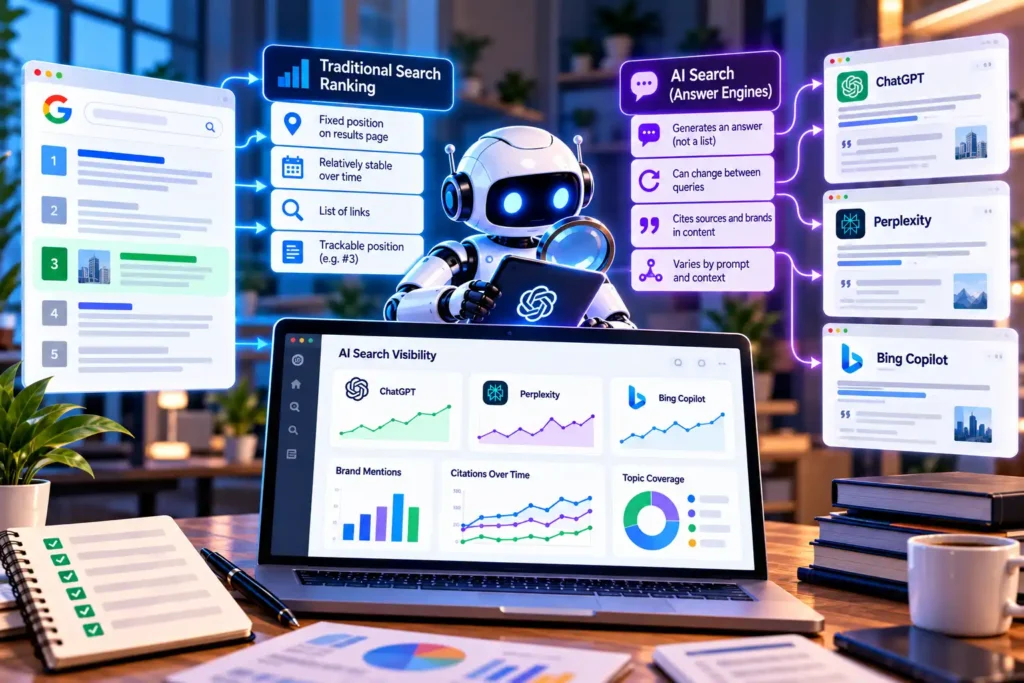
Ask ChatGPT or Perplexity the same question twice in the same week, and you can get two different answers, with different brands cited, different sources pulled, and different phrasing used to describe the same product category. The model is weighing context, prompt phrasing, and its own retrieval process fresh each time, not pulling from a stored index position.
This is why a single check doesn’t tell you anything useful, and why trying to track AI search rankings the same way you’d track a Google position misses the point entirely. One prompt, run once, showing your brand cited is not evidence of visibility it might be luck, a session artifact, or a prompt variant that happens to favor you. AI search visibility measurement only becomes meaningful once you’re tracking a pattern across repeated prompts, repeated platforms, and repeated time periods.
Some teams call this answer engine visibility, since platforms like ChatGPT and Perplexity behave like answer engines generating a response rather than link directories returning a ranked list. The name matters less than the practice: consistent, repeated sampling instead of a one-time check.
For your business, this changes what “checking your visibility” even means. It’s not a monthly rank report. It’s a repeatable sampling process the same questions asked the same way, on a schedule, so you can see the pattern instead of a single noisy data point.
The Metrics Actually Worth Tracking: Visibility Rate, Citation Sources, Share of Voice
Three AI visibility metrics carry most of the useful signal for AI search performance tracking. Everything else is a variation or a subset of these.
Visibility rate is the percentage of your prompt set where your brand gets mentioned at all cited by name, recommended, or referenced as a source. If you run 25 buyer-intent prompts across a platform and your brand shows up in 9 of them, your visibility rate on that platform is 36%. Track this per platform, not as one blended number, because visibility rate on ChatGPT and visibility rate on Perplexity often diverge sharply for the same brand.
Citation sources tell you which of your pages the AI system is actually pulling from when it does cite you and, just as important, which competitor pages it’s pulling from when it doesn’t. This is where AI citation monitoring earns its keep: if your product pages never appear as a source but your old blog posts do, that’s a specific, fixable gap, not a vague “improve your content” note.
Share of voice measures how often you appear relative to named competitors across the same prompt set. If a prompt about “industrial pump suppliers” returns three brand names and you’re one of them, that’s a share of voice of roughly 33% for that prompt track it across the full set to get a stable number. This metric matters more than visibility rate alone, because appearing in 40% of prompts means little if a competitor appears in 90% of the same set.
These three metrics run consistently give you an accurate picture of AI search performance without needing a dashboard. What they need instead is a repeatable process, which is the next problem to solve.
Setting Up a Manual Baseline Without a Paid Tracking Tool
Here’s how to track AI visibility without paying for a monitoring subscription: you need a fixed process, run consistently enough to produce a trustworthy baseline. This is a form of generative search monitoring you can run entirely by hand, provided you’re disciplined about the process.
Build a real prompt set first. Pull 20-30 actual buyer questions not guess, but the phrasing real prospects use. Sales call transcripts, support tickets, and “people also ask” boxes on Google are the best sources. A prompt set built from questions your team hears every week produces a far more accurate baseline than one built from what you assume people ask.
Run the set across at least three platforms. ChatGPT, Perplexity, and Google AI Overviews cover most of where B2B buyers are actually researching right now. Running the same prompt set across all three, rather than just one, is what turns a single data point into a comparable baseline a brand can perform very differently across platforms.
Log results the same way every time. For each prompt, record whether your brand was mentioned, which competitors were mentioned, and which source URL (if any) the AI system cited. A shared spreadsheet with these four columns prompt, platform, mentioned yes/no, cited source is enough for basic brand mention tracking. What matters is that the format stays identical every run, so week-over-week comparison is actually valid.
This is also how businesses without a large marketing budget measure brand visibility in AI platforms without paying for a subscription tool up front.
Run it on a fixed weekly cadence. A one-off check tells you almost nothing, for the same reason a single Google rank check told you almost nothing about long-term trend. Weekly runs, logged consistently, are what let you see whether visibility rate is moving and give you an early warning if a platform update quietly drops your citations.
Fewer than 20 prompts, or an inconsistent schedule, produces a baseline too noisy to act on you’ll see the numbers swing without being able to tell if that’s a real trend or just sampling noise.
When Manual Tracking Stops Being Enough
Manual tracking works well for a single brand running a modest prompt set on a weekly cadence. It stops working at a specific, predictable point.
If you’re tracking more than roughly 30-40 prompts across three or more platforms, the logging time alone starts to outweigh the value of doing it by hand what took an afternoon starts eating a full day, every week. If you need daily rather than weekly checks, because visibility is moving fast enough that a week-old data point is already stale, manual logging can’t keep pace. And if you need to track sentiment (not just whether you’re mentioned, but how favorably) alongside citation sources, that’s a layer of nuance manual review struggles to score consistently.
At that point, a paid AI visibility monitoring tool earns its cost not because manual tracking was wrong, but because the volume outgrew what a spreadsheet can hold accurately. The manual method described above is still the right way to start: it tells you whether AI search visibility is even worth investing further tooling budget into, before you commit to a subscription.
Turning Visibility Data into an Actual Plan
Measurement only matters if it changes what you do next. Once you have a few weeks of consistent data, three moves come directly out of it.
If visibility rate is low but citation sources show your pages occasionally getting pulled, the fix is usually about how a handful of pages are structured not a wholesale content rebuild. If citation sources rarely include your domain at all, even when you’re mentioned by name, the gap is more likely about third-party references and how discoverable your technical content is to a crawler in the first place.
Falcon Pumps, an industrial manufacturer, used this exact combination of metrics to guide its AI SEO strategy after finding that engineers researching pump specs on ChatGPT and Perplexity simply weren’t finding them. Tracking visibility rate and citation sources showed precisely which technical pages needed restructuring for AI retrieval and which topics had no citable source at all.
The result was a 586% increase in traffic from generative AI sources and a 420% increase in qualified leads from AI platforms, alongside a 185% increase in visibility in Google AI Overviews. Falcon Pumps is now cited as a Recommended Supplier on ChatGPT for a core product search a direct, checkable outcome of measuring first and then acting on the gaps the data revealed.
The pattern holds regardless of industry: measurement tells you where the gap is, so the content and technical work that follows is targeted instead of guessed at.
What to Set Up This Week
Start with the prompt set, not the tracking sheet. Pull 20-25 real buyer questions from sales calls or support tickets, run them across ChatGPT, Perplexity, and Google AI Overviews, and log visibility rate, citation sources, and share of voice in a simple spreadsheet. Repeat weekly for a month before drawing conclusions a single week’s data isn’t a trend yet.
Once you have a baseline and can see which pages get cited and which don’t, formatting is usually one of the first fixable causes behind a low citation rate. Optimize content for AI crawlers and search engines walks through how to structure pages so AI systems can actually pull from them, which is the natural next step once your measurement shows where the gaps are.