

Key Takeaways:
- Content for AI search engines needs a different kind of formatting discipline than content written purely for human readers scanning a page.
- Semantic HTML gives AI crawlers a structural map of your content, not just styling the difference between a heading tag and bold text is a difference AI system actually read.
- Structured content hierarchy helps both AI crawlers and human readers follow an argument, which is why the two rarely conflict when done well.
- Chunking content into single-idea sections is what actually determines whether an AI system can parse a page cleanly, and it’s the step most guides skip entirely.
- Machine readable content isn’t only about prose tables, lists, and definition structures often communicate faster and more reliably than paragraphs covering the same information.
- AI crawler accessibility depends on formatting choices that are easy to fix once you know what to look for, not a wholesale content rewrite.
Why “Optimizing for AI Crawlers” Means Something Different Than Classic SEO
Classic SEO optimization mostly assumes a human reader scanning a page, with search engines inferring structure from visual cues and behavior signals. AI crawler optimization works differently these systems parse a page’s underlying structure directly, and formatting choices that look identical to a human visitor can read very differently to a machine.
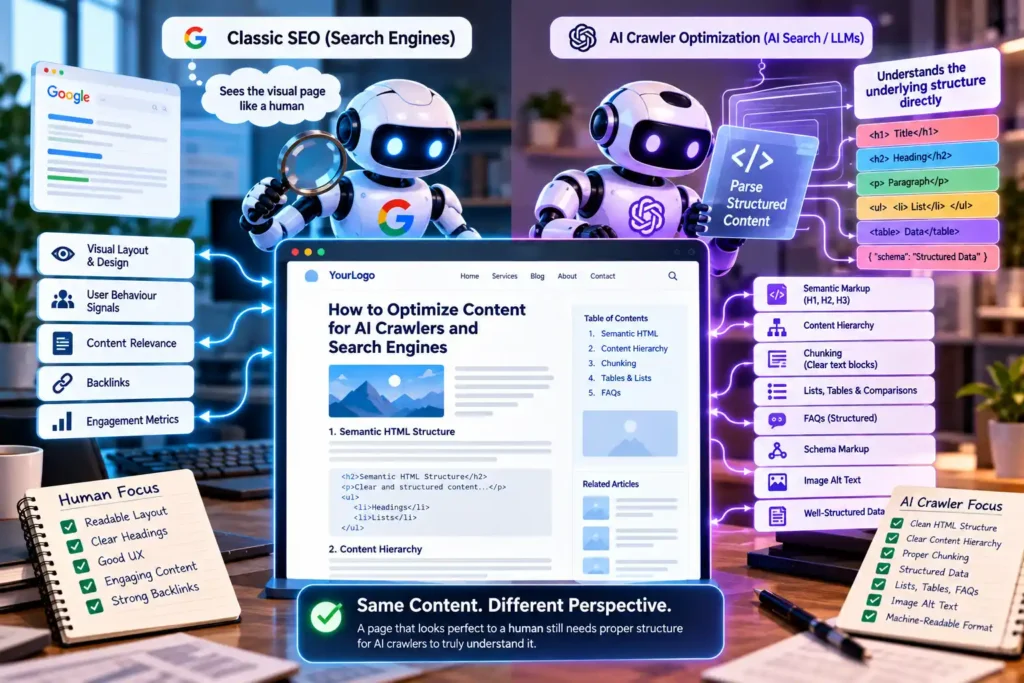
This post is deliberately scoped to that formatting layer: semantic markup, hierarchy, chunking, and non-prose formatting. It doesn’t cover AI crawler access the robots.txt and technical permissions layer since that’s covered in detail elsewhere on this blog, and repeating it here wouldn’t add anything new.
For your business, this means treating AI crawler accessibility and content formatting as two separate problems, not one. A page a crawler can fully reach still needs to be formatted in a way that crawler can actually make sense of. Whether the goal is to optimize website for AI search broadly or fix a single high-value page, the formatting layer covered in this post applies the same way either time.
Semantic HTML as the Foundation AI Crawlers Actually Parse
Semantic HTML means using tags that describe what content actually is, not just how it looks. A heading tag signals “this is a heading” to anything parsing the page; a bold, larger-looking line of text styled to resemble a heading signals nothing structural at all, even if a human reader can’t tell the difference visually.
This distinction matters more for AI systems than it ever did for traditional search. When a page is broken into meaningful, well-labeled pieces, an AI system can identify which part answers which question far more reliably than when the same information sits in a wall of visually-styled but structurally flat text.
Website optimization for AI crawlers starts here because it’s the cheapest fix with the broadest effect: converting visually-styled text into actual heading tags, list tags, and paragraph tags rarely changes how a page looks to a human visitor, but it changes everything about how a machine reads it.
Beyond headings and lists, tags like article and section group related content into logical containers, giving a parser clear boundaries around where one topic ends and another begins. A page built from generic, unlabeled containers gives none of that structural signal, even if the visual layout looks perfectly organized.
For your business, this means auditing your most important pages for tags that only look structural rather than actually being structural. A quick way to check: view a page’s HTML directly and see whether headings are genuine heading tags or just styled text pretending to be one.
Structuring Content Hierarchy So Both Crawlers and Readers Can Follow It
Structured content hierarchy is the logical nesting of ideas a page’s H1 states the main topic, H2s break it into major sections, and H3s handle sub-points within those sections, in an order that makes sense if you read only the headings.
This matters for AI parsing because heading hierarchy functions like a table of contents a machine can navigate without reading every word. A page with a clean, logical hierarchy lets an AI system jump directly to the section relevant to a specific question, rather than processing the entire page to find it.
A common mistake is using heading levels for visual sizing rather than logical structure dropping to an H4 because it “looks right” on the page, even when the content is actually a peer of the H2 above it rather than a sub-point of it. This breaks the logical map the hierarchy is supposed to represent.
A quick before-and-after makes this concrete: a page with five H2s and no sub-headings, covering distinct sub-topics under each, tells an AI system almost nothing about how those sub-topics relate. The same page with H3s correctly nesting each sub-topic under its parent H2 gives the parser a genuine outline to follow instead of a flat list.
For your business, this means reviewing heading structure as an outline first, separate from how it renders visually. If you can’t summarize a page accurately by reading only its headings in order, an AI system parsing that same hierarchy will struggle just as much.
Chunking Content into Sections AI Systems Can Actually Parse
Chunking is how you break content into sections sized for how AI systems actually process text, rather than however long a section happens to run when you’re writing. Most guides on this topic stop at “use semantic HTML and schema” and never address chunking directly, which is exactly the gap this section fills.
A useful working rule: each section under a heading should cover one idea completely, in roughly 100 to 250 words, before moving to the next heading. Sections much longer than that tend to blend multiple ideas together, which makes it harder for an AI system to isolate the specific piece relevant to a given question.
This doesn’t mean cutting content short it means splitting genuinely long sections into more headings rather than one long block. A 900-word section covering five related points reads more cleanly to both AI crawlers and human readers as five shorter sections, each with its own heading, than as one continuous block.
Crawl able website content benefits from this same discipline at the page level too. A page that’s one continuous scroll of text with only a handful of headings is harder to chunk meaningfully than one broken into clearly delineated sections throughout.
A simple check: scroll through a page and count how many headings appear per 1,000 words. A page with two or three headings across 1,000 words is almost certainly under-chunked; five to eight headings covering the same length usually signals sections sized closer to what parses cleanly.
For your business, this means reviewing your longest-running sections first anywhere you’ve written more than roughly 300 words under a single heading is worth checking for a natural break point. This single formatting change often does more for AI parsing than any other fix on this list.
Machine-Readable Formatting Beyond Prose
Tables, lists, and definition structures often communicate information faster and more reliably to an AI system than the same information written out in paragraph form. A comparison between three options, for instance, is far easier to parse as a table than as three paragraphs of prose describing each one.
Semantic content structure extends to these formats too an actual HTML table with proper header cells reads differently to a machine than text visually arranged to resemble a table using spaces or line breaks. The same applies to ordered and unordered lists versus a paragraph that just happens to mention several items in sequence.
AI search accessibility improves noticeably on pages that use these formats where the content genuinely calls for them a step-by-step process as an ordered list, a set of options as a table, a set of terms and their meanings as a definition list rather than forcing everything into prose regardless of what the content actually is.
This doesn’t mean reaching for a table or list everywhere possible. Content that’s genuinely narrative an explanation that depends on the order ideas build on each other usually stays clearer as prose, and forcing it into a table just to check a formatting box tends to strip out the context that made it useful in the first place.
For your business, this means looking at your existing content for places where prose is doing a table’s job or a list’s job. Reformatting these sections is usually a quick win that doesn’t require writing any new content at all.
What to Do Next
Start with semantic HTML on your highest-value pages: check whether headings, lists, and paragraphs are using genuine structural tags rather than text styled to look the part. This is the fastest fix with the broadest effect across everything else on this list.
From there, review heading hierarchy as an outline, independent of how it renders visually, and look for sections running longer than roughly 300 words under a single heading these are your best candidates for chunking into smaller, more focused sections.
Formatting fixes like these address how a page communicates its structure, not whether AI crawlers can reach it in the first place. If you’ve done this work and your content still isn’t appearing in AI-generated answers, [Why AI Search May Ignore Your Website Content] (/blog/ai-seo/why-ai-search-ignores-website-content/) walks through the other patterns worth checking next.