

Key Takeaways:
- Amazon treats a parent-child variation family as one browsing unit, but review pooling and keyword competition still work independently between siblings.
- The default variant Amazon shows in search results converts at roughly 3-4x the rate of its siblings, driven by search position rather than product quality.
- A phased Amazon policy change running February 12 through May 31, 2026 will split review counts for any variation with a “substantive difference” from its siblings.
- Variations help visibility when customers compare the options as one buying decision, and hurt it when backend terms get copy-pasted across children instead of tailored to each variant.
- Auditing default-variant selection and backend search-term overlap takes under an hour and often catches visibility loss before conversion rates show it.
Why a Variation Family Behaves Like One Listing to Amazon’s Algorithm
Amazon’s search index treats a parent-child variation group as a single browsing entity, even though each child ASIN has its own backend data which is exactly why amazon product variations seo requires thinking about the family first, not just the individual listing. Shoppers land on one detail page and pick a size, color, or scent from a dropdown. They rarely see individual child ASINs as separate search results unless a specific variant ranks on its own for a niche query.
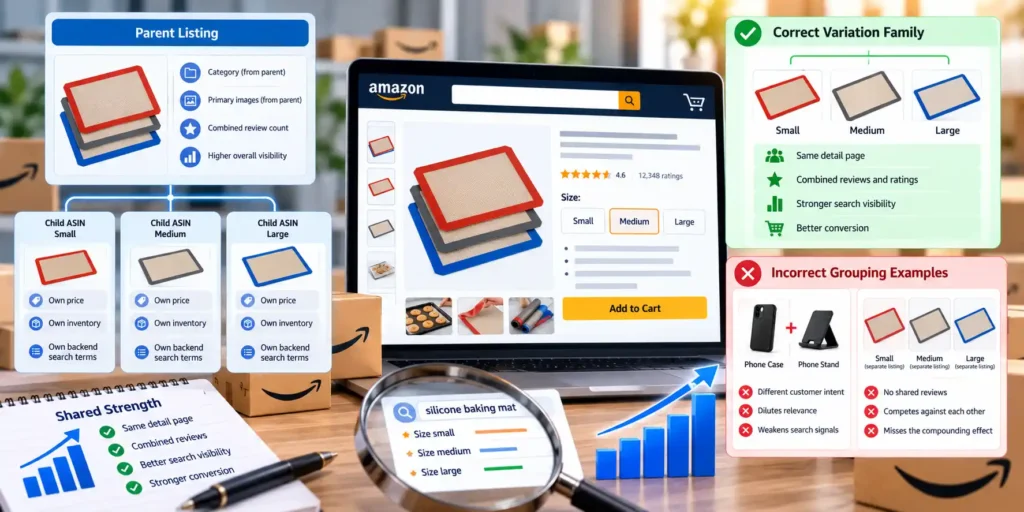
This is the core of amazon parent child seo: the parent listing carries the category assignment and primary images, while each child ASIN still controls its own backend search terms, price, and inventory. Variation listing structure determines how much of that shared strength each child inherits versus how much it has to earn independently.
Get the parent child relationships wrong too many unrelated products crammed into one family, or too few variants split into separate listings that should be unified and you lose the compounding effect variations are supposed to create. For your business, this means the family-level decision comes before any single-listing optimization: fix the structure first, then optimize individual children.
A silicone baking mat sold in three sizes illustrates the point. Grouped correctly as one family, all three sizes share the parent’s category standing and combined review count, so a shopper searching for any size lands on a listing with full social proof behind it. Split into three unrelated listings instead, each size starts from zero competing for the same keyword with none of the shared strength the family structure was supposed to provide.
The reverse mistake shows up just as often. A seller bundles a phone case and a completely different phone stand into one “accessory bundle” family because they ship together, even though a shopper searching for a phone stand has no interest in a case. Amazon still treats that pairing as one browsing decision, which dilutes both products’ relevance signals for their actual search terms instead of strengthening either one.
A quick way to spot a family that’s grouped wrong: look at the search terms each child ranks for independently. If two children in the same family are ranking for entirely different queries with almost no overlap, that’s a sign they’re serving different customer intents and were never really one buying decision to begin with regardless of how the listing was originally set up.
Default-Variant Selection: The Search-Position Advantage Most Sellers Miss
When a shopper searches and your product family appears, Amazon shows one specific child ASIN by default not a random rotation. That default variant sits in the primary search-result position, and industry data suggests it converts at roughly three to four times the rate of its siblings simply because of where it appears, not because it’s a better product.
Amazon weighs stock availability, price competitiveness, review strength, and recent conversion rate when assigning the default. A child ASIN that’s frequently out of stock or priced above its siblings gets rotated out of the default slot one of the clearest asin ranking signals sellers can actually influence.
Amazon variation listing optimization starts at the family level, but child asin optimization tightening backend terms, images, and price for each individual variant is what determines whether that structural advantage actually converts. This is where variation keyword targeting and default-variant management intersect: if your highest-margin or best-converting variant isn’t the one showing up first, you’re leaving amazon variation rankings on the table for reasons that have nothing to do with keywords.
Consider a family of five color variants, each converting at a similar baseline rate on its own. If the default slot rotates to whichever color happens to be best-stocked that week, the family’s overall conversion rate swings with inventory timing rather than with which color customers actually prefer. A seller who instead keeps the strongest-converting, best-reviewed color in stock and priced competitively holds the default position deliberately and captures the multiplied search-position advantage on the variant most likely to convert anyway, instead of leaving it to whichever ASIN Amazon rotates in next.
Default-variant selection also compounds with the review-sharing question in the next section: a default variant with a thin review history looks weaker in that top search-result slot than one that inherited a strong shared review count. Getting the default right and getting the review picture right are two separate levers, but they reinforce each other.
The Incoming Change to Review-Sharing Across Variations (Feb-May 2026 Rollout)
Amazon is changing how reviews are shared across variation families in a phased rollout running February 12 through May 31, 2026, with 30 days’ notice given per category before it takes effect. Variants with only cosmetic differences color, pattern, same-function sizing, pack quantity, secondary flavor or scent, device fit keep pooled reviews.
Variants with substantive differences work differently. Different performance specs, old-versus-new model generations, bundles versus standalone units, primary flavor or scent as a core attribute, different materials, or design changes affecting fit or use will have their review counts split apart from the rest of the family.
This directly affects product variation visibility. A family that’s been coasting on one variant’s strong review history, while other children hide behind it, will see those weaker children’s real review counts exposed once the split takes effect which can shift both their conversion rate and their standing in search.
Industry modeling on this exact scenario is worth noting, though it’s a general illustration rather than a Growth Naavik client result: a family of five color variants averaging 28 reviews each, converting at 70-75% of a comparable standalone listing’s baseline rate, pooled into a single 140-review parent and each variant’s conversion climbed to 90%+ of that baseline. That gap the difference between 28 reviews and 140 pooled reviews is exactly what the 2026 split threatens to reopen for any family with substantive-difference variants.
For your business, this is a narrow window to review how your own variation family is grouped before the rollout reaches your category. If a variant you’re counting on to inherit the family’s review strength actually falls into a substantive-difference bucket, its real, standalone review count not the pooled number you’re used to seeing is what will show up in search once the split lands.
Amazon’s own guidance frames the change as protecting review accuracy for shoppers comparing meaningfully different products, not as a penalty against sellers. That framing doesn’t change the practical outcome for your business: any variant that’s been quietly under-reviewed while riding a stronger sibling’s numbers is about to be judged on its own standalone record, in search and at the point of purchase alike.
When Variations Help Visibility and When They’re Working Against You
Amazon listing variations help visibility when the pooled review count and shared browse-node placement genuinely represent one buying decision a shirt in five colors, a supplement in three pack sizes. The family benefits from combined social proof and a single listing competing for one set of search terms instead of five listings splitting that same demand.
They work against you when the variants target genuinely different search intent, or when backend terms get copy-pasted across children instead of tailored to each one’s specific attributes. That’s a separate cannibalization problem, not a variation-structure problem, and it shows up as siblings competing for the same keyword instead of the family strengthening its position. If a specific child isn’t showing up in search at all, that’s a sign of variation indexing issues a separate, narrower problem than the family-level visibility this post covers.
Three concrete signals point toward splitting an existing family rather than leaving it as-is: star ratings that diverge sharply across variants (one child sitting below a 4.2 average while siblings sit well above it), keyword demand that clearly diverges by variant instead of overlapping, and search-result cannibalization where two of your own children compete for the same query. None of these signals means the variation structure itself is wrong they mean this particular family has drifted from the “one buying decision” test it was built on.
The flip side matters just as much before you split anything: if every variant genuinely serves the same job for the customer and search behavior overlaps heavily across children, splitting the family throws away the pooled review count and shared browse-node standing you’d have to rebuild from zero on each new standalone listing. Splitting is a real fix for a genuinely divergent family, but it’s an expensive one to apply to a family that only looks divergent because of a keyword-overlap problem sitting one layer above the structure itself.
Optimize amazon variations by testing this one question for every variant: would a customer searching for this specific version want to land on a different result than a customer searching for another variant in the same family? If yes, that variant may not belong in this family at all. If no, structure is not your problem something else is, and it’s worth ruling that out before restructuring.
Auditing Your Variation Family for Search Visibility
Start with three checks. First, confirm which child ASIN currently holds the default position and whether it’s actually your best-converting variant if not, that’s a conversion opportunity independent of keywords. Second, map your variants against Amazon’s February 12 through May 31, 2026 review-sharing categories: anything with a substantive difference should get its own review-building plan before the split reaches your category.
Third, run a listing variation strategy check on backend search terms each child should have terms specific to its own attributes, not a copy-pasted set from the parent. If you find your children fighting each other for the same terms instead of covering different ground, [amazon keyword cannibalization] (/blog/amazon-marketing/amazon-keyword-cannibalization/) covers what’s likely causing it and how to separate the family’s keyword targeting child by child.
A fourth check is worth adding once the first three are clean: pull each variant’s individual star rating and review count as they stand today, before the February 2026 rollout reaches your category, so you have a baseline to compare against once any substantive-difference variants split off. Sellers who wait until their category’s rollout notice arrives are auditing under time pressure; sellers who check now are just confirming what they already expect to see.
For your business, these checks take under an hour and catch the visibility loss most variation families never notice until conversion rates start slipping.