

Key Takeaways:
- Pet service searches rarely start with “near me” alone pet owners mix in symptoms, service type, and urgency (“emergency vet open now,” “same-day dog groomer”) depending on what’s actually happening.
- Once results appear, pet owners scan a short, consistent list of signals in roughly the same order: proximity, star rating and recent reviews, photos, and whether the business looks open and active right now.
- Most pet owners compare a small number of options, not a long list usually two to four, with the comparison often ending the moment one business responds first.
- Emergency searches and routine searches look almost nothing alike: proximity and “open now” dominate an emergency search, while reviews and price research dominate a routine one.
- A business can be fully visible in local search and still lose the moment, if it’s slow to answer or presents an unclear starting point to a pet owner already deep into comparing.
The Exact Searches Pet Owners Run When They Need a Local Pet Service
Pet service searches are rarely just “[service] near me,” even though that phrase shows up constantly in search data. A pet owner dealing with a limping dog searches “emergency vet near me open now.” One whose regular groomer just closed searches “dog groomer like [old business name] near me.” The underlying need is the same find a local option but the actual pet owner Google searches look different in each case.
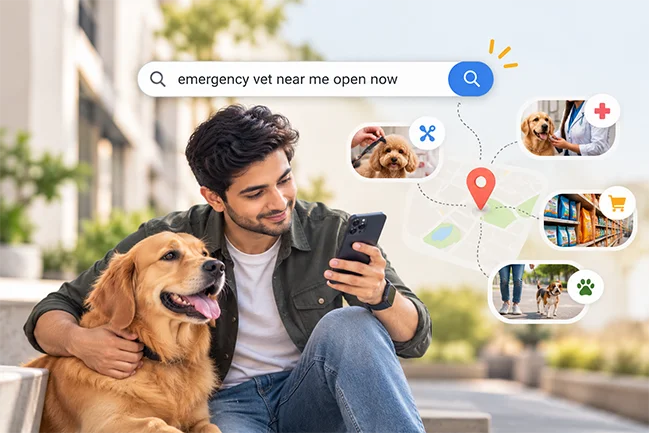
Finding pet services online also happens through phrasing that has nothing to do with location at first. “Why is my cat not eating” or “best food for a dog with allergies” are pet service searches in disguise informational on the surface, but one clicks away from “[vet/pet store] near me” once the pet owner has enough context to know what kind of business they actually need. Local pet service searches often begin one step earlier than the local query itself.
Location based searches also vary by how precisely the pet owner already knows their own area. Someone new to a neighborhood searches “dog boarding [city],” while someone who’s lived there for years searches “dog boarding [specific street or landmark]” or simply “near me” and trusts their phone to handle the rest. Google search queries for pet services skew more specific as a decision gets closer to being made, the same way they do for other local service categories.
Voice search adds one more layer worth naming directly: “find a vet near me that’s open now” spoken into a phone produces a longer, more conversational phrasing than anyone would type, and it’s becoming a meaningful share of pet services near me searches as voice assistants get used more during an actual pet emergency, hands-free, mid-crisis.
A fair share of local pet service searches is also brand-remembered rather than generic a pet owner recalling “that vet on [street name]” or “the grooming place with the orange sign” searches for fragments of a name or location detail rather than a clean business name, especially right after moving or switching providers. These searches test very differently in keyword tools than they behave in reality, since no tool captures “the place my neighbor recommended near the park.” Breed-specific local searches add another layer “French bulldog-friendly groomer near me” or “exotic vet for rabbits [city]” because not every local pet business handles every animal equally well, and pet owners have learned to ask for the match up front.
For a pet business, this means the query someone used to find you reveals more about their situation than the keyword list alone ever will.
What Pet Owners Actually Look At Once the Results Appear
Once a local search returns a map and a list, pet owners scan it in a fairly predictable order. Proximity comes first almost by default, because Google already sorts by distance and most people start at the top. But proximity alone rarely closes the decision it just sets the initial shortlist.
Star rating and review recency come next, and they get weighed together, not separately. A 4.9 rating built from reviews two years old reads as less trustworthy to most pet owners than a solid 4.6 with reviews from the last few weeks, because recent activity signals the business is actually still operating the way the listing describes. This is part of what makes local search behavior around pet services feel more cautious than browsing a retail product page.
Photos matter more for pet services specifically than for most other local categories, because a pet owner is handing over something they care about, not buying a commodity. A grooming salon’s before-and-after photos, a boarding facility’s actual kennel space, a vet clinic’s waiting room these do real work in a decision that’s partly emotional, not purely logical. A listing with zero recent photos reads as neglected even if everything else about it is accurate.
Whether a business looks “open and active right now” is the final filter, especially for anything time-sensitive. Hours that don’t match what’s actually posted on the door, a phone that rings with no pickup, or a GBP profile with months-old posts all push a pet owner toward the next option on the list rather than waiting to find out. Nearby pet services that look inactive lose consideration even when they’re the closest physical option.
A worked comparison makes the ordering concrete. Listing A sits 1.2 miles away with a 4.9 rating built mostly from reviews over a year old and three photos uploaded at setup; Listing B sits 2.1 miles away with a 4.6 rating, recent reviews from the past month, and a dozen current photos including last week’s results. Most pet owners choose Listing B, trading a few extra minutes of distance for the stronger signal that the business is actively, recently doing good work right now.
Most of this scanning now happens on a phone, in a map view swiped through one listing at a time rather than compared side by side in a desktop tab. That format pushes photos and the single most visible review even higher in influence, since there’s rarely room on a small screen to read three or four reviews deep before swiping to the next listing. A profile’s single best-displayed photo is doing more work than most pet businesses realize.
For a pet business, this means the four signals above proximity, rating-plus-recency, photos, and visible activity are doing nearly all of the work before anyone ever calls, which is exactly the groundwork a pet marketing agency typically starts with before touching anything else.
How Many Options Pet Owners Really Compare Before Choosing
Despite Google often surfacing a dozen or more results, most pet owners only seriously compare two to four. Pet service discovery narrows fast: the first filter (proximity and open status) usually removes half the list before anyone reads a single review.
Of that shortlist, the comparison itself is often resolved by whoever responds first rather than by a side-by-side feature analysis. A pet owner messaging three groomers at once through Google’s built-in message button books with whichever one replies within the hour, not necessarily the one with the single best rating. This favors responsiveness over polish in ways that surprise pet businesses who assumed reviews alone decide the outcome.
For routine, non-urgent needs, the comparison window stretches out and the pet owner’s own research habits show up more reading a handful of reviews in full rather than skimming the star count, checking a business’s own photos on its profile instead of relying only on what Google surfaces, sometimes asking in a local pet owner Facebook group before searching at all. Local buying intent here builds over days, not minutes.
How far a pet owner will travel also depends heavily on what’s being searched for. A routine grooming appointment might pull from a three-to-five-mile radius, since there’s no urgency forcing a shorter list, while an emergency vet search effectively excludes anything more than ten or fifteen minutes away regardless of how good the reviews are further out. Pet service discovery radius shrinks hard the moment a decision needs to happen today rather than this month.
For a pet business, this means losing to a slower-but-better-rated competitor almost never happens losing to a faster-responding, adequately-rated one happens constantly.
Why an Emergency Search Looks Nothing Like a Routine One
An emergency pet service search collapses every signal down to two: how close, and how fast. A pet owner searching “emergency vet near me open now” at 11pm is not reading reviews in depth or comparing photos they’re calling the first result that’s both close and clearly reachable right now. Local search behavior under urgency strips out almost everything else.
A routine search runs the opposite way. Someone booking a grooming appointment three weeks out, or researching boarding for a trip next month, has time to read reviews carefully, compare pricing where it’s listed, and even revisit a shortlist over several days before deciding. Location based searches for routine needs often start broader too “best groomers in [city]” rather than the tightly scoped “near me” an emergency produces.
The practical middle case is the semi-urgent one a pet that’s “probably fine but acting off,” a boarding need discovered four days before a trip and this is where pet owners behave least predictably, sometimes rushing like it’s an emergency and sometimes researching like it’s routine, often switching between the two mid-search as new information changes how worried they are.
Time of day changes this further, independent of how serious the actual issue is. A symptom noticed at 2pm on a Tuesday still allows for a same-day appointment search with some comparison built in, while the same symptom noticed at 11pm collapses straight into the emergency pattern regardless of how mild it later turns out to be. Pet owners calibrate urgency partly on the clock, not only on what’s actually wrong.
For a pet business, this means a single generic listing has to perform well for two almost opposite kinds of visitor, which is a harder design problem than it first appears the same profile needs to reassure an unhurried researcher and answer an urgent caller within the same few minutes of each other’s attention.
Where to Start
Look at your own local listing the way a pet owner mid-search actually would: is the distance obvious, are the last few reviews recent, do the photos look current, and would a stranger believe you’re open right now just from what’s visible. Most gaps here are five-minute fixes, not strategic overhauls.
If you’ve confirmed this and visibility still isn’t the issue pet owners are finding you but not choosing you, or not choosing you fast enough Local SEO for Pet Businesses: How to Get Found by Pet Owners Near You covers the fuller setup behind each of these signals, from Google Business Profile mechanics to the review system that keeps recency working in your favor.
Revisit this comparison exercise every couple of months, especially after any change to hours, location, or staff a listing that was accurate in January can quietly become the “looks inactive” option by summer without anyone on the team noticing from the inside.
One more thing worth checking: how your listing would read to someone in a genuine hurry versus someone with time to browse, since most businesses have unknowingly optimized for only one of those two visitors. A quick way to test this is asking someone unfamiliar with your business to find and evaluate your own listing in under thirty seconds, the way a worried pet owner actually would.