

Key Takeaways:
- Website structure and SEO are directly connected: search engines use your site’s hierarchy to decide how much authority to pass to each page and how important each one is.
- Pages buried more than 3–4 clicks from the homepage get crawled less often and rank worse, even when the content on them is genuinely strong.
- Orphaned pages with no internal links pointing to them waste content investment because neither crawlers nor visitors can easily find their way there.
- Inconsistent URL structure and taxonomy confuse crawlers about how your content relates to itself, which dilutes topical authority you’ve already built.
- The Shillong Tours fixed technical and structural SEO foundations before growing organic traffic 50% in 6 months and reaching Top 10 rankings on multiple high-intent keywords.
- Restructuring a site that’s already live is riskier than building structure from scratch the fix order matters as much as the fixes themselves.
Why Website Structure Is a Ranking Factor, Not Just a UX Preference
Search engines don’t just crawl pages individually they crawl the relationships between them. Your site’s structure is how you tell a crawler which pages matter most, how they relate to each other, and where to spend a limited crawl budget. Website structure and search engine crawlability are directly linked, since structure is effectively the map crawlers use to find everything else on the site.
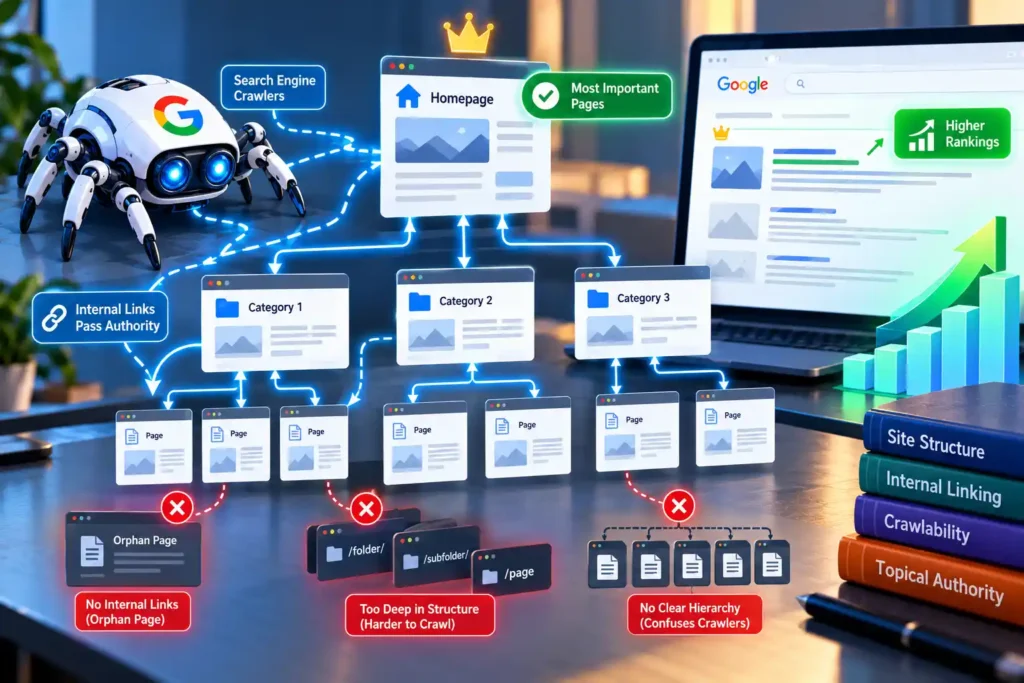
Link equity flows through internal links the same way authority flows through backlinks, just at a smaller scale. A page linked from your homepage and three category pages carries more signal than the same page buried four folders deep with a single link from an old blog post.
Structure also disambiguates topics for search engines the way a table of contents disambiguates them for a reader. A flat site with no clear hierarchy makes it harder for a crawler to tell which pages represent your core services and which are supporting content, which weakens topical authority across the board.
For your business, this means structural problems don’t show up as an obvious symptom the way a manual penalty or a broken page does they show up as content that should be ranking, quietly not ranking as well as it should. Getting website architecture SEO right starts with recognizing this pattern, not with jumping straight to a single technical fix.
Deep Hierarchies and Crawl Depth
Click depth is simply how many clicks it takes to reach a page starting from your homepage. Pages sitting five or six clicks deep get crawled less frequently than pages closer to the surface, and get crawled less thoroughly when they are crawled at all. Crawl depth issues like this are often invisible until you actually measure click depth directly, rather than assuming your navigation menu reflects it accurately.
This matters more on larger sites. A site with 40 pages rarely has a real crawl-depth problem; a site with 4,000 pages spread across a deep category tree can easily have important pages that crawlers visit once a month instead of once a week. Good website hierarchy SEO practice keeps anything genuinely important within reach of that budget, rather than trusting that quality alone will get a page crawled.
Check your own site’s depth using a crawl tool that reports click depth alongside each URL, and look specifically at your highest-value pages’ service pages, top-converting content, anything you’d want ranking well. If any of them sit more than three or four clicks deep, that’s worth fixing before anything else on this list.
For your business, this means the fix usually isn’t “flatten the entire site” it’s identifying which specific pages are both important and buried, and pulling them closer to the surface with better internal linking. The connection between website hierarchy SEO is rarely obvious until you look at click depth and internal linking together, rather than treating them as separate issues.
Orphaned Pages and Weak Internal Linking
An orphaned page is a page that exists, might even be indexed, but has no internal links pointing to it from anywhere else on the site. Crawlers rely heavily on internal links to discover and revisit pages, so an orphaned page is effectively invisible to the process that would otherwise help it rank. Orphaned website pages are more common than most site owners expect, and they rarely announce themselves the way a broken page or a 404 does.
This happens more often than most site owners expect old blog posts that fell out of the navigation during a redesign, landing pages built for a campaign that ended, category pages replaced by a new taxonomy but never actually delinked from. The content is still there; the path to it isn’t.
Weak internal linking causes a milder version of the same problem: a page technically has links pointing to it, but they’re all from low-authority pages, or the anchor text gives crawlers no useful context about what the page is actually about. A weak internal linking structure creates exactly this kind of problem at scale, quietly capping pages that would otherwise be strong performers.
For your business, this means auditing for orphaned pages is worth doing even on a site you think is fully linked a full-site crawl compared against your XML sitemap usually surfaces pages that quietly fell out of the link graph without anyone noticing. Website hierarchy optimization starts with fixing exactly this kind of gap, since it’s the safest and lowest-risk place to begin.
URL Structure and Taxonomy Problems
A clean URL structure mirrors your site’s actual hierarchy a service page living under a category folder that matches its actual category, not a flat structure where every page sits directly off the root domain regardless of how it relates to anything else. This is one of the clearest examples of what website structure SEO problems actually look like in practice pages that are individually fine but collectively disorganized.
Inconsistent taxonomy causes a specific kind of damage: when similar content lives under different URL patterns because it was built at different times by different people, crawlers have a harder time understanding that the content belongs to the same topic cluster, which dilutes the topical authority that cluster could otherwise build. Building an SEO-friendly website structure means grouping related content by URL path consistently, not just by whatever made sense to whoever built each page at the time.
Restructuring URLs to fix this is worth doing carefully, not casually. Every URL change needs a 301 redirect from the old address to the new one, and skipping that step or doing it inconsistently can lose more ranking value than the taxonomy problem it was meant to fix.
For your business, this means URL cleanup is a real fix, but it’s also the one most likely to cause short-term damage if it’s rushed. Plan the redirect map before changing a single URL, not after. URL structure optimization is the highest-risk fix on this entire list, which is exactly why it belongs last, not first.
What to Fix First If You’re Restructuring a Live Site
Building clean structure into a new site is straightforward. Restructuring a site that’s already ranking, already indexed, and already generating traffic is a different problem entirely, because every change risks temporarily disrupting what’s currently working.
Start with orphaned pages and internal linking gaps first these are close to zero-risk fixes, since you’re adding links rather than moving or removing anything that’s already indexed and ranking. Crawl-depth fixes come next, usually by adjusting navigation and internal linking rather than physically moving pages.
URL and taxonomy changes should come last, and only with a complete redirect map in place before a single URL changes. This is also where the risk of doing real damage is highest, so it deserves the most caution and the most testing before it goes live.
The Shillong Tours went through exactly this kind of technical and structural cleanup before seeing the payoff: fixing crawlability and keyword structure issues first, then building out organized content clusters on top of that foundation, and growing organic traffic 50% in 6 months while reaching Top 10 rankings for multiple high-intent travel keywords and generating 100+ leads a month.
For your business, this means the order of operations matters as much as the individual fixes restructuring the highest-risk elements first, before confirming the lower-risk fixes are working, is how good intentions turn into a traffic drop instead of a traffic gain.
What to Do Next
Fixing website structure and SEO problems on a live site means working in order of risk, not in order of what feels most broken. Start with orphaned pages and weak internal linking these are safe, additive fixes. Then address crawl depth for your highest-value pages by adjusting navigation and internal links rather than physically relocating content.
Save URL and taxonomy restructuring for last, and only with a full redirect map planned before you touch a single URL. Rushing this step is the single most common way a structural fix turns into a temporary ranking loss instead of a gain.
If you’re not sure whether structure is actually your bottleneck, or you want a second opinion before touching a site that’s currently generating traffic, [SEO and Web Design: What to Know Before You Rebuild] (/seo/learn/seo-and-web-design/) covers how structural decisions made during a redesign affect SEO outcomes.