

Key Takeaways:
- The businesses ChatGPT names for your buyer questions are your real competitors for those questions, so build your competitor list from its answers, not from your sales deck.
- Five kinds of evidence separate a named competitor from an unnamed business: independent mentions, brand information coverage, category clarity, consistency across sources, and reviews and community presence.
- A 0 to 2 score per category per competitor turns a vague gap into a ranked work plan, with the gaps you control (your own pages and profiles) first.
- Some gaps, such as years of press coverage, will not close in a quarter, so target narrower questions where a competitor’s evidence is thin.
- Fabricated reviews and planted mentions do not survive a buyer checking them, so the only evidence worth building is real.
- Falcon Pumps secured 23 high-authority technical placements and was named a Recommended Supplier on ChatGPT for “Industrial Pump Distributors Northeast”.
Which Competitors Is ChatGPT Naming, and for Which Questions?
Competitors appearing in ChatGPT answers are visible evidence, and visible evidence can be audited. Start by finding out exactly who ChatGPT names. Build a short panel of buyer questions, using the setup method in How to Measure Your Brand’s Visibility Across AI Search Platforms.
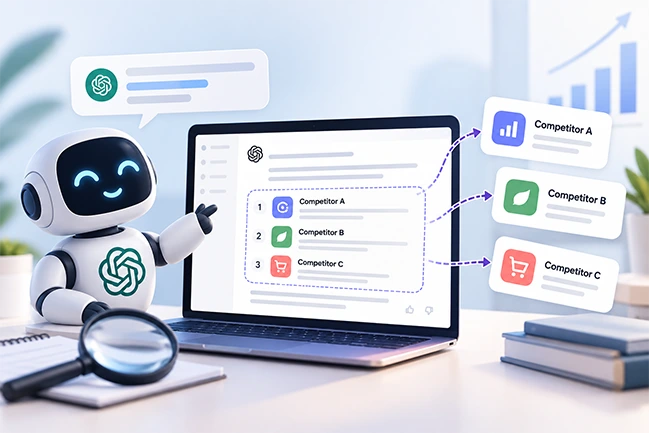
Record every business ChatGPT names in each answer, and tally how many panel questions each one appears in. That tally is each competitor’s ChatGPT competitor visibility, and your own count goes in the same column. Why AI recommends competitors can differ by question, so one rival may win your category question while another wins a different one.
Word the questions the way a buyer would, such as the best provider of your service for a specific need. Do not include your own brand name, because that tests whether ChatGPT knows you, not whether it picks you. Ask each question two or three times, since the names can shift between runs.
The list may surprise you. ChatGPT can name larger brands, adjacent services, or directories that you never think of as rivals. For each question, the businesses named are your competitors for that question, whether or not they compete with you for sales.
Check whether each answer showed source links. OpenAI’s help page says responses that search can include inline citations and a Sources list. If sources appear, open them, because they show what stands behind each name.
If no sources appear, the answer came from what the model already holds. A competitor named from memory has been mentioned often enough, in enough places, for the model to recall it. That is evidence you can look for, and the next section shows how.
Keep one boundary in mind. If ChatGPT gets your own business wrong, or does not know it exists, start with Why Is ChatGPT Not Recommending My Business? This post assumes ChatGPT knows you and still picks others.
Choose the two or three competitors named most often and write their names across the top of a sheet. Competitor mentions in AI answers will shift as you re-run the panel. The names you pick now are a starting set, not a permanent list.
For your business, this means your real competitor set is the list ChatGPT produces, not the list in your sales deck. Audit those names first, and set aside rivals that never appear.
What Evidence Does Each Competitor Have That You Don’t?
When ChatGPT recommends competitors again and again, there is usually evidence behind it that you can find. For each competitor, compare five kinds of evidence. You can check every one yourself with a search engine and about an hour per competitor.
This audit does not reveal how ChatGPT ranks anything, because OpenAI’s help page does not describe how results are chosen. It shows what evidence exists for each business, which is the part you can change.
Independent mentions. Search the competitor’s name plus your category, then read what appears beyond their own website. Note the trade publications, comparison pages, forum threads, podcasts, and directories that name them. Competitor brand mentions on pages they do not control are the evidence your own site cannot supply.
Brand information coverage. Open the competitor’s key pages and note the factual detail they publish: services, specifications, pricing approach, locations, and answers to buyer questions. A business that states specifics gives an AI system more to quote than one that publishes only adjectives. Count the facts on their pages, then count the facts on yours.
Category clarity. Read each competitor’s homepage and ask what it says the business is and who it serves. Then write one sentence describing each business as a stranger would. If theirs is easy to write and yours takes several tries, you have found a gap.
Consistency. Look up each competitor’s name, address, category, and offer across their website, Google Business Profile, LinkedIn, and directories. Consistent details make it easier for any system to treat separate mentions as one business. Run the same check on your own listings, because inconsistency on your side shows up as a gap here.
Reviews and community presence. Check third-party review sites, forums, and question-and-answer threads for how customers describe each competitor. These pages describe a business in customers’ words, which no company can write about itself. Compare how many exist for them and for you.
Write each finding down as a fact, not an impression. “The competitor has six independent mentions and you have one” can be scored later, while “they seem more established” cannot.
Together, these five checks are the business recommendation signals you can actually observe. A side-by-side brand authority comparison across them shows where a competitor’s evidence is thicker than yours, and where it is not.
For your business, this means a competitor’s advantage is rarely one thing. It is usually a stack of small evidence gaps, and the audit shows you each layer instead of one vague deficit.
How Do You Score the Gap and Decide What to Close First?
Give each category a score for each competitor. Score 0 if the competitor is clearly ahead, 1 if you are roughly level, and 2 if you are clearly ahead. Add the five scores for a total out of 10.
Suppose you score 0 for independent mentions and reviews, and 1 for information coverage, category clarity, and consistency. That totals 3 out of 10. The two zeros show where the competitor’s evidence is thickest.
Write the scoring rule before you look at the evidence, and use counts wherever you can. Count independent pages for mentions, count published facts for information coverage, and count reviews on the same sites. A second person should reach the same score from the same notes.
Now rank the gaps by how much of the work you control. Information coverage, category clarity, and consistency live on your own pages and profiles, so you can start today. Reviews depend on your customers, and independent mentions depend on other publishers.
That gives you a fix order. Close the gaps you control first, ask for reviews next, and build independent mentions alongside both because they take longest. Treat it as an AI SEO work plan: controllable fixes first, then review, with mention-building running in parallel.
To improve brand recommendations in AI, aim to move your total toward each competitor’s, one category at a time. Competitive AI visibility is the result: how often ChatGPT names you alongside these competitors for the same questions. Track it with the metrics in the measurement guide linked above rather than inventing your own.
For your business, this means a score of 3 out of 10 is a plan, not a verdict. Each category becomes a specific piece of work with an owner and a date.
Which Gaps Are Not Worth Chasing, and What Should You Never Fake?
Some gaps will not close quickly, and pretending otherwise wastes budget. A competitor with a decade of press coverage and thousands of reviews holds evidence that took years to accumulate. You will not match it in a quarter.
Pick the questions where their evidence is thin instead. A narrower question, such as a specific use case, product type, or city, often has fewer businesses with strong evidence behind them. Winning there builds the mentions and reviews that make broader questions reachable later.
Here is a hypothetical case. A software vendor cannot outrank the market leader for “best accounting software for small businesses”. It can target “accounting software for dental practices”, where far fewer pages and reviews exist, and become the named answer there first.
Falcon Pumps shows the evidence-first route. An AI SEO engagement secured 23 high-authority technical placements, including engineering guides, equipment comparisons, and industry best-practice articles. Falcon was then named a Recommended Supplier on ChatGPT for “Industrial Pump Distributors Northeast”, a category-and-region question where ChatGPT chooses between businesses.
Never fake the evidence. Do not buy reviews, plant mentions, or publish comparison pages that invent claims about a competitor. Anything fabricated has to survive a buyer checking it, and a competitor with real evidence will hold up better.
Be equally careful with what you read about competitors. ChatGPT can state a competitor’s pricing or features wrongly, and repeating that in your own content spreads the error. Verify any competitor detail on the competitor’s own site before you use it.
For your business, this means you should choose your battles by evidence, not ambition. Close the gaps you can close honestly, and win the narrower questions first.
How to Tell Whether Closing the Gap Is Working
Re-run the same panel after each round of fixes, using identical wording. Log which businesses ChatGPT names, whether you are among them, and which sources it shows. Keep the log in the same format each time so the comparison is fair.
Watch the sources as closely as the names. If a page you published starts appearing in the Sources list for a panel question, your evidence is being found. That holds even if you are not yet named, and it can be an early sign of progress.
Re-score the five-category grid at the same time. A competitor’s score can rise too, so a flat total on your side may still mean progress if the gap is narrowing. Compare the gap, not your score alone.
Watch for new names too. A competitor you had not audited may enter your panel answers after a few runs. Add that business to your next round of scoring.
Expect uneven movement. Changes to pages ChatGPT retrieves can show up in searched answers sooner than changes to what the model already learned. Do not judge a fix on a single run.
For your business, this means progress shows up as a narrowing gap and new sources before it shows up as a recommendation. Log both, so you can tell a fix that is working from one that has not landed yet.
What to Do Next
Spend one afternoon on this, then repeat it monthly:
- Ask ChatGPT five buyer questions in your category, without your brand name, and write down every business it names.
- Pick the two or three named most often, and note whether each answer showed sources.
- Score each competitor against you on the five categories, from 0 to 2 each.
- Fix the lowest-scoring category you control: information coverage, category clarity, or consistency.
- Re-run the same questions and re-score after the fix.
Once your grid shows where you are behind, the next question is how ChatGPT decides between two businesses that both have strong evidence. How AI Search Engines Choose Which Brands to Recommend covers that selection logic.