

Key Takeaways:
- ChatGPT chooses whether to search the web based on the question you ask, so the same business can be missing from one answer and present in the next.
- An answer with source links searched the web; an answer without them came from what the model already holds, and each result calls for a different fix.
- Three outcomes cover almost every case: ChatGPT does not know your business, it knows you but states wrong details, or it describes you correctly and still does not suggest you.
- Testing four question types (branded, category, comparison, problem-led) shows whether the gap is recognition, authority, or content, because a business can win one type and lose another.
- Wrong details in a ChatGPT answer almost always trace to an outdated page, directory, or profile, so the correction happens at the source, not inside ChatGPT.
- Falcon Pumps was absent from ChatGPT answers for pump specifications until 23 technical placements and 8 AI-focused placements helped it become a Recommended Supplier on ChatGPT for “Industrial Pump Distributors Northeast”.
Did ChatGPT Search the Web, or Answer From Memory?
Start with one question before anything else: did ChatGPT search the web to answer you? OpenAI states that ChatGPT “will choose to search the web based on what you ask.” You can also trigger a search manually. A business not showing in ChatGPT on Monday can therefore appear on Tuesday, simply because the question or the setting changed.
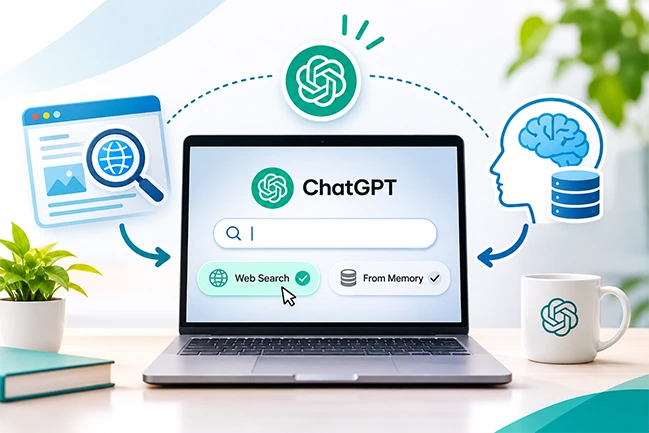
You can see which path ChatGPT took. Answers that searched include links to sources, and a Sources button opens the full list of references. An answer with no sources came from what the model already holds about the world.
This distinction changes what a missed mention means. If a searched answer skips you, the problem sits with the pages and sources ChatGPT found for that question. If an answer from memory skips you, the model may never have absorbed enough about your business to name it.
Newer businesses and recent rebrands are the most exposed. A company that changed its name or services in the last year can find ChatGPT describing the old version. The old pages and listings still exist, and they have had longer to spread than your updates.
OpenAI also says ChatGPT search draws on third-party search providers and content from its partners, without naming them. That means nobody outside OpenAI can tell you exactly which source fed a given answer. Treat any guide that names the specific sources as inference, not fact.
Run the test in two passes. Ask your buyer question and note whether sources appear. Then ask it again with the web search icon selected and compare the two answers.
For your business, this means you should record whether sources appeared before you record whether you were mentioned. The two outcomes point to different fixes, and mixing them up sends you after the wrong problem. Why ChatGPT is not recommending my business has more than one answer, and this first test shows which to chase.
What Is ChatGPT Actually Saying About Your Business?
Ask ChatGPT a direct question about your business by name, then read the answer line by line. You will land in one of three situations, and each one is a different problem. It does not know you, it knows you but gets details wrong, or it describes you correctly but never suggests you.
If ChatGPT says it has no information, or confuses you with a similarly named company, you have a business entity recognition problem. The model cannot tie your name to one distinct company with a clear offer. Common triggers are a thin website, a name shared with other businesses, and details that differ across your listings.
If ChatGPT knows you but states the wrong services, an old address, or a discontinued product, you have a brand information accuracy problem. The model is repeating something it found somewhere: an outdated directory, an old press release, or a page you forgot to update. The wrong answer is a symptom, and the source of the wrong detail is the real target.
If the description is accurate but you never appear when a buyer asks for options, the gap is usually third-party brand references. ChatGPT sees your own claims, but few independent pages name you next to the problem you solve. Without outside confirmation, AI brand recommendations go to competitors that have it.
For your business, this means “ChatGPT doesn’t mention us” is not a diagnosis. Why ChatGPT doesn’t mention my company depends on which of these three situations you are in. Reading its answer about your name takes about two minutes.
Why Do Competitors Appear for Some Questions and Not You?
ChatGPT can name you for one kind of question and ignore you for another. Test four types.
Ask a branded question, such as what your company does. Ask a category question, such as the best provider of your service. Then ask a comparison question (you versus a named competitor) and a problem-led question (how to fix the issue you solve).
Write down the result for each. A business that appears for branded questions but not category questions has recognition without authority. ChatGPT knows you exist, but it sees no independent reason to put you ahead of the others in the category.
Category questions are the hardest to win. Every competitor in your market is fighting for the same few slots.
AI answer selection favours whichever businesses have the clearest and most widely confirmed information. Being absent here is common even for businesses with strong Google rankings.
Missing from comparison questions usually means no page places you next to your competitors. Missing from problem-led questions usually means your own pages do not answer that problem directly. Both are content gaps, and both are visible only when you test the question type separately.
If you sell locally, add your location to the question and check whether the answer lists businesses at all. Note which sources it shows. Do not assume which directory or map listing it reads, because OpenAI does not publish that.
Answers can differ between runs, so ask each question two or three times. Treat a single result as one data point and look for the pattern across runs.
Here is how a finished grid reads. Suppose you appear for your branded and problem-led questions, but vanish on category and comparison questions.
That pattern says your content answers the problem well, while the web holds too few pages that place you among your competitors. The next step is third-party content, not more pages on your own site.
For your business, this means a single failed test tells you very little. A grid of four question types, each tested a few times, shows whether your gap is recognition, authority, or content.
Which Fix Matches Which Symptom?
ChatGPT brand visibility problems usually trace to one of four causes, and each has a different first fix. Match what you saw in the tests to the cause below, and work on one at a time. Fixing all four at once makes it impossible to tell which change moved the result.
Symptoms overlap, so start with the cause that sits lowest in the stack. A business with wrong details usually also has inconsistent listings, and inconsistent listings weaken recognition. Clearing that up often improves two symptoms at once.
If ChatGPT does not know your business at all, fix recognition first. Make your business name, address, category, and core offer identical across your website, Google Business Profile, LinkedIn, and any directory that lists you. Then add Organization schema so your site states plainly who you are and what you sell.
This is where AI SEO work normally starts. Nothing else compounds until the model can identify you.
If ChatGPT states wrong details, correct the source of the error. Searched answers show their sources, so open them first. The correction process is covered in the next section.
If searched answers never include your pages, check whether your content is reachable and extractable. OpenAI says any website or publisher can choose to appear in ChatGPT search, so a block on your side is worth ruling out. Why AI Search May Ignore Your Website Content walks through the access and content causes in detail.
If ChatGPT describes you accurately but does not recommend you, build independent references. That means guides, comparisons, and industry articles that name your business in the right context. How Brand Mentions Influence Visibility in AI Search covers how to build them.
Falcon Pumps, an industrial pump manufacturer, started with this problem. Engineers were asking ChatGPT and Perplexity for pump specifications, and Falcon did not appear.
An AI SEO engagement then secured 23 high-authority technical placements, including engineering guides, equipment comparisons, and industry best-practice articles. It also added 8 placements built to answer technical questions raised in AI tools. Falcon was named a Recommended Supplier on ChatGPT for “Industrial Pump Distributors Northeast”.
For your business, this means the order matters more than the volume of work. If you want to get business recommended by ChatGPT, fix recognition before authority. Fix wrong details before you build new references, because new mentions built on inconsistent information inherit the inconsistency.
How to Correct Wrong Information ChatGPT Repeats
Wrong information is the one symptom you can fix with a clear paper trail. Start by copying every incorrect statement exactly as ChatGPT wrote it. Do not paraphrase, because the exact wording is what you will search for next.
Search for each claim and find where it lives. Check your own website first, then the profiles you control, then directories, review sites, press mentions, and old PDFs.
The details that go stale most often are service lists, pricing models, opening hours, office addresses, and the names of founders or leadership. If a searched answer displayed sources, open those pages before anything else, since they are the most likely origin.
Fix errors in this order: your own pages, the profiles you control, then third parties. For third-party sites, send a short correction request with the right facts and the page address where the error appears. Keep a log of every request and its status, because corrections across several sites take time to land.
Then give the correct facts one clear home. A single page that states your current services, locations, and key details in plain language gives future answers something accurate to find. Keep that page consistent with every profile that describes you.
Answers from memory behave differently. Editing a page does not change what a model already learned, so the goal is consistent, accurate information across sources before later model updates.
Recheck with the same four question types after your fixes, and keep the same wording each time so the comparison is fair.
For your business, this means correcting ChatGPT is really a source-cleanup job. You cannot edit the model directly, but you can remove the outdated pages and conflicting listings that keep feeding it the wrong version.
What to Do Next
Block out thirty minutes and run this check on your own business today:
- Ask ChatGPT a branded, a category, a comparison, and a problem-led question about your market.
- For each answer, note whether source links appeared, then repeat the question with the web search icon selected.
- Record whether you were absent, described wrongly, or described correctly but not recommended.
- Pick the one symptom that appears most often and apply only its fix from the section above.
Re-run the same four questions after your fix, using identical wording. To track this across ChatGPT and other AI tools on a repeatable schedule, read How to Measure Your Brand’s Visibility Across AI Search Platforms. It shows how to set up that testing so you can see what actually moved.